

© Steve Ullathorne
What have I learned in the 25 years since The Naked Racist?
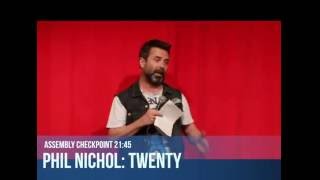
Phil Nichol revisits his award-winning breakout show
Twenty years ago, The Naked Racist marked a defining moment in my career. The show won awards, sparked debate, and asked audiences to confront uncomfortable truths about prejudice, identity, and politics through comedy.
Now, two decades later, I’m bringing The Naked Racist back.
At first glance, it might look like nostalgia, a chance to revisit a successful show and introduce it to a new audience. But revisiting work after 20 years involves far more than remembering old routines or updating references.
Comedy ages differently from most art forms. It lives or dies on context. What once felt edgy most definitely becomes ordinary; what once seemed harmless can suddenly feel outdated and offensive. As seen with shows like Little Britain, The League of Gentlemen, and On The Buses, cultural context is everything.
Even typing the title The Naked Racist feels like I should be holding it at arm’s length with tongs, like it’s something that might still be warm in the middle.
It isn’t, of course. It’s 20 years cold. Which is part of the problem. Or part of the point. Or possibly both, depending on how generous you’re feeling and whether you’ve had lunch.
But that’s part of the challenge, and maybe the point.
When I first performed it, I thought I was saying something urgent. That’s what you believe when you’re younger: that your thoughts are immediate and original rather than recycled fragments of something you’ve seen on TikTok.
The show emerged in the shadow of the Iraq War, when public trust in government was eroding and conversations about race, nationalism, and global conflict were becoming increasingly polarised.
That war, that moment, felt like rupture. Now it feels like precedent. And that’s a depressing kind of progress. Not much seems to have changed.
So here I am again, trying to reconstruct something built from urgency in a world that has kept moving without waiting for permission. The question isn’t just whether the jokes still land. It’s whether the framework they rely on still makes sense.
Comedy lives in context. And context never stands still.
Comedy never stands still
Stand-up has always reflected its cultural moment. Each generation redraws the boundaries of what can be said, how it can be said, and who gets to say it.
As a veteran comedian of 40 years, I exist in a slightly charmed position. I’ve seen these shifts from the stage while also adapting to them. That gives perspective, but it also does create risk: assuming that what worked before will continue to work.
Language is the first thing to change. Words that once felt precise become blunt. Others expand or shift meaning entirely. A certain few words are simply no longer acceptable in any context. What felt like clarity begins to feel like something that hasn’t kept up. And somewhere in that gap, I still have to stand on stage and speak. Yikes.
That requires a kind of personal optimism I don’t fully recognise anymore.
It also requires acknowledging something else: I am, broadly speaking, part of what gets described as the demographic of older, cisgender white men in comedy.
Privilege and perspective
That reality shapes how material is written, and how it is received. This isn’t about apology or punching yourself in the nuts, nor is it about claiming authority over conversations increasingly shaped by the more diverse voices around me. Who doesn’t like getting punched in the nuts?
It is about recognising that perspective matters. Who speaks influences how what is said is heard.
The same sentence can land differently depending on the person delivering it. Audiences don’t separate content from context; they interpret both together.
This creates tension that cannot be ignored. But it can be examined.
I often find myself trying to slow things down, not to resist change, but to understand what exactly has changed, and whether we even agree on the language we’re using to describe it.
It sometimes feels like we’re arguing about the same things we always have, just with updated vocabulary that nobody can fully keep up with. 6-7.
Recognising this doesn’t make comedy impossible. It demands more awareness of framing and responsibility.
The aim isn’t to avoid difficult subjects but to approach them with greater care.
Words change. Ideas remain.
One of the most striking discoveries in revisiting The Naked Racist is how much language has changed while underlying arguments remain familiar.
Terms that barely existed 20 years ago now dominate public discussion. Ideas about identity, privilege, inclusion, unconscious bias, and representation are now central to mainstream conversation.
Yet the core disputes remain unchanged.
People still argue about belonging. About fairness. About identity and difference. About prejudice and bigotry.
The labels evolve. The human questions do not.
This has created a challenge for my older material. Sometimes it requires translation rather than replacement. The ideas may still be valid, but the language must be updated for a new audience.
Comedy is often presented as if it is fully in control. It rarely is. It’s closer to someone trying to explain a complex feeling and be taken seriously while flying low in public. Zip it, loser.
And then there’s the internet…still behaving as though it has just discovered disagreement. Does everyone have to have a valid opinion on absolutely everything? Ffs.
Political déjà vu
Back then, The Naked Racist was shaped by my frustration over the Iraq War. I was younger, angrier, and deeply affected by what felt like a catastrophic political decision and ultimately, the unacceptable human cost. Is Tony Blair a war criminal or did he have to take that course of action?
And, here we are again today. Feels familiar, doesn’t it?
Conflict persists. Polarisation has intensified. Trust in institutions remains fragile. Public discourse is shaped by outrage, misinformation, and division.
This raises an ongoing tension between intention and reception, between what is meant, what is heard, and what happens in between.
Part of me is also curious whether my old material still works, not as something to preserve, but as a way of understanding who I was when I wrote it.
Sometimes the answer is unsettlingly close to who I am now. Sometimes it isn’t.
Both are useful.
Culture runs ahead
Culture often moves faster than politics. Artists and comedians frequently explore social change before institutions acknowledge it.
Comedy can test ideas early, creating a place where difficult conversations become possible.
But it also reveals repetition. Every generation believes its debates are new, when they are often variations of old arguments.
What feels like progress is sometimes just recycling with different terminology.
Still, I don’t think of this as preservation. Preservation implies the value has already been agreed upon.
This feels more like rummaging.
Rummaging through a drawer you’ve avoided for years and finding not just old receipts and black nail polish but an earlier version of yourself stuck to it all.
There’s something oddly emotional about seeing your past self trying, even when clumsy or wrong. It reminds you that your language never quite lived up to its intention.
And more importantly, that most people are, at some level, simply, just trying.
Comedy exists in that gap between intention and understanding. It doesn’t resolve disagreement. It makes it audible without forcing you to a conclusion.
Can old comedy learn new tricks?
Rather than treating The Naked Racist as a museum piece, I want to treat it like a new conversation. Some material remains unchanged. Some has been reworked. Some has been removed entirely.
That process mirrors comedy itself: constant revision, testing, and adaptation. The difference is the gap between the two versions is twenty years.
This raises questions not just about the material, but about me, myself and I.
Can I still challenge my own assumptions? Can I recognise blind spots that were previously invisible? Can experience coexist with curiosity?
These questions sit at the centre of the project.
Comedy as self-examination
There is also a simpler truth: it’s vanity to revisit old successful work.
Every comedian eventually becomes ‘legendary,’ which often just means people assume you’ve stopped working.
What’s most revealing is what still works and what doesn’t. Some material feels surprisingly fresh. Other parts feel dated in ways that may as well have been written in Latin. ‘Hic spectaculum mire placet’- ***** The Roman Times
That contrast is useful. If everything still worked, it would suggest nothing had changed. And that would be more worrying.
We are supposed to evolve, to revisit, to occasionally cringe at our former selves. If you don’t, it likely means you haven’t learned much.
Listening has also become central. Comedy doesn’t work without it. Otherwise it’s just noise delivered into a void; my favourite type of comedy, by the way.
Finding common ground
Modern online discourse rewards absolute certainty and seeds division. Comedy offers something different: ambiguity.
It allows contradictions to exist without resolution. It invites audiences to laugh together at shared human flaws rather than compete over them.
That shared laughter doesn’t solve political conflict. But it creates moments of connection that make disagreement bearable. Or does it?
Comedy doesn’t fix anything. It simply makes things briefly understandable without demanding immediate resolution.
Will We Ever Find Peace in Comedy?
Comedy will never escape the tensions around it. As long as society remains divided, comedians will have to navigate disagreement, offence, and shifting expectations. To ask difficult questions without pretending easy answers exist. To challenge audiences while remaining open to being challenged.
Language changes. Politics evolves. Culture shifts.
Comedy remains one of the few tools capable of holding all of that at once.
Bringing back The Naked Racist
Twenty years on, I’m bringing back The Naked Racist not because it belongs unchanged in the present, but because the questions it asks still matter.
If anything, revisiting it shows both how much has changed, and how much hasn’t.
Definitions evolve. Generations shift. Politics cycles.
Comedy, at its best, keeps asking why.
In revisiting the work, I’m not just reviving old material. I’m revisiting myself, the person who created it, and all my assumptions behind it.
And if nothing else, it’s reminded me of one simple truth:
Always keep your old notebooks.
Not because the jokes are timeless, but because they show you who you were, and how far you’ve come, even when you haven’t changed quite as much as you wished you had or foolishly, assumed you had.
• Phil Nichol’s The Naked Racist will be at the Gilded Balloon at 9.45pm from August 5 to 18. He also has a new stand-up show, Aren’t We Lucky’ will be at the same venue at 5.20pm all month. He will also be appearing in 11½ Angry Men at the Pleasance EICC Pentland Theatre from 5 to 22 at 2.30pm.
Published: 27 Jul 2026
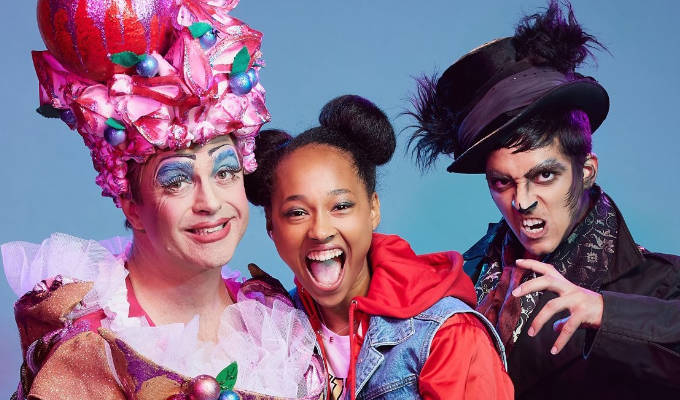
Phil Nichol and Daliso Chaponda star in their first pantos
Phil Nichol and Daliso Chaponda are to star in…
23/09/2021
A celebration of beautiful idiocy
I was thrust into the comedy world at the age of 20…
8/09/2020
The lesson? Take some chances!
Worst gig and best gig
At Edinburgh in 1996,…
19/08/2019
Phil Nichol joins West End musical
Stand-up Phil Nichol has joined the cast of West End…
4/10/2017
Phil Nichol: Nearly Gay and The Naked Racist
Some comics reflect the audience’s own lives back…
7/11/2012
A comic has been claiming that Phil Nichol directed…
17/08/2011
Edinburgh award-winners Brendon Burns and Phil Nichol…
4/09/2008
Chortle last month broke though the 20,000 visits a…
1/07/2007
Outspoken Scottish politician Tommy Sheridan is to…
8/05/2007
A team of stand-ups is to climb the highest mountains…
8/05/2007
Billy Connolly, Eddie Izzard, Frank Skinner and Jimmy…
2/05/2007
More stand-up shows will be available on DVD after…
7/02/2007

Products
DVD (2012)
Phil Nichol: Nearly Gay/The Naked Racist
DVD (2012)
Holy Flying Circus
DVD (2007)
Broken News Series 1
Past Shows
Agent
Glorious Management
Contact by email
Lower Ground Floor
79 Noel Road
N1 8HE
Office: 020 7704 6555