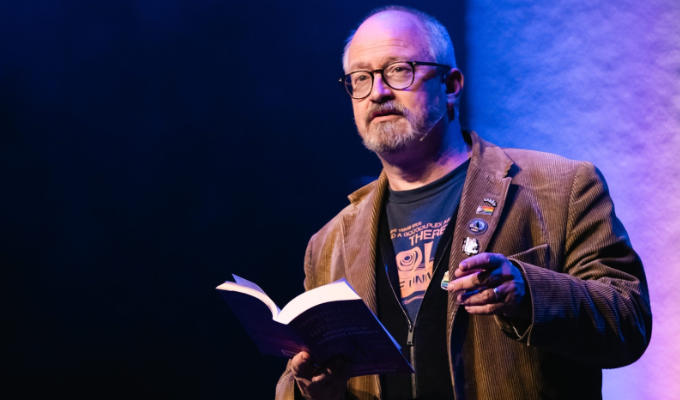


The Future Of Jokes, by Robin Ince
Book review
The Future Of… series of books from publisher Melville House UK offers a range of easily digestible, extended-essay length books pondering everything from war crimes to bananas (honestly!)
Now Robin Ince joins the roster with his thoughts on the state of jokes, as comedy battles AI threats, tribalistic culture wars and the rise of comedians as brands, constructing their personas by feeding online algorithms.
Ince’s own brand, though not built especially by design, is of liberal curiosity. In a world where the question of comedy’s future is so often built around what can’t be said any more, Ince happily introduces himself by saying: ‘I hate the jokes of my past. I would happily incinerate all of them.’ Because how can you grow if your attitudes and humour do not change?
‘Please God, do not let me become someone who complains about the youth of today.’ Ince says, noting how those he once shared progressive views with are now ‘banging on about the woke’.
Attitudes change, yet too often, people ‘remain tied to the apron strings of [their] teenage taste’ the former Infinite Monkey Cage host writes. ‘If you are not careful, you’ll find yourself telling people that the jokes that are around nowadays just aren’t funny. There’s a comfort in reassuring yourself that you were the best generation.’
In support of his persuasive argument not to let your personal sense of humour become ossified, Ince cites how Comic Strip Presents creator Peter Richardson sometimes re-edits his old films, seeing it as a way of gaining a new audience and remaining relevant (or simply just making a better, tighter product) rather than ‘damaging a cultural artefact’.
On culture wars or beyond, many of Ince’s comments seemed aimed at fellow comedians, as he generally urges them to be more thoughtful in their craft, and ideally more experimental.
However, he recognises that comics with a certain level of fame will find it difficult to evolve beyond what fans know and expect. He counts himself lucky that he measures success in the enjoyment he gets from experimenting with ideas, not follower numbers or TV deals.
‘Fame will often harden the mould of who you can be,’ he writes. ‘Big-name acts are expected to deliver a product that is reassuring in its familiarity. Fortunately, I’ve not been cursed by huge wealth and success, so I can keep tinkering about…
‘What I have learned about my future in comedy is that what I hoped for once is not what would have made me happy now, and probably wouldn’t have done then. Creativity trumps popularity.’
But Ince believes – indeed hopes – that some of the more formulaic comedians will be in the firing line of AI.
‘Some comedians want to be products,’ he writes. 'There is a lot of money in being a product. Products are easier to sell. People know what they are going to get… I think those comedians will be replaced by AI. Actually, I hope some of them will be.’
But while artificial intelligence can unpick word-puzzle type gags – and surely in time replicate the rhythms and content of a relatively hack comedian, the gulf between generative bots and human consciousness remains vast. Ince is hopeful that comedy won't be lost to the programs anytime soon. How could any robot understand his comedy hero Rik Mayall’s genius in making bad jokes sizzle?
‘When a machine leaves the stage triumphant and believes the next machine in the spotlight will fail, and observes with a sneering visual function, consciousness will really be in the electrodes,’ Ince writes. ‘To laugh is to empath. To laugh is to feel relieved that you are not the person making a hash of getting that piano upstairs like Stan or Ollie, while at the same time feeling it will be you.’ Can androids do that?
Even with the onset of AI (to which Ince is not immune; he confesses to having used ChatGPT to generate some talking points for this book) the hope is that humans performing comedy IRL will still exist in the future, however much people increasingly find their funny on Instagram and TikTok,
As anyone who’s attended the Edinburgh Fringe will know, the live scene has witnessed an exponential rise in what Ince calls ‘the confessional and the confrontational, often with a vast amount of empathy’. The diversity of subject matter is the definitive counterargument to the tired grumble that ‘you can’t make jokes about anything nowadays’ from those fighting the inevitability that their attitudes have become outdated.
As Ince says: ‘You can whine that [the preponderance of more personal comedy] is woke if you want, but there’s still plenty for you… Another of my dreams for the future is that we realise it is more fun to discuss what you love and bond over what you mutually hate.’ That might be one of his biggest pipe dreams of all.
While some comics seek to build empathy, others ‘pretend they are rebels by being even more vicious to marginalised people,’ Ince points out. How can you be a renegade when you parrot the bigoted bullying of the US President, who has been so depressingly successful in harnessing the dark side of how a jokey attitude is now more crucial to political discourse than ethics.
‘Creating an illusion of a sense of humour is a very useful way of appearing more attractive and deflecting from your hostile and destructive actions,’ Ince writes. ‘It’s only a joke... It’s all only a joke.’ Out on the stump is the one place he hopes jokes don’t have a bright future.
• The Future Of Jokes by Robin Ince is published by Melville House UK tomorrow, priced £9.25 from Amazon – or for £9.49 from uk.bookshop.org, below, which supports independent bookstores.
Published: 4 Nov 2026