


God’s Fools
Review of a book linking eccentric saints to modern comedians
When making a list of saints and sinners few would put the likes of Richard Pryor, Dave Chappelle and Lenny Bruce in the first category.
But Jason Crawford, professor of English at Union University in Tennessee, here argues that there is more in common between edgy comedians and celebrated men of God than you might think.
Of course, there is much overlap between any charismatic preacher and a skilled stand-up, but Crawford also lays out how some early Christian figures were lords of misrule, precursors to modern comedy via the likes of commedia dell'arte and Shakespeare.
There are certainly parallels with the examples he cites, though with more than 10,000 saints recognised by the Catholic church you can probably find a beatified example of any personality trait you care to mention.
Holy Fools are, by definition, figures who act in a deliberately outrageous way to shatter the illusions of the sane and the worldly so as to be able to critique conventional norms, while their ragged appearance and grubby behaviour convey purity and honesty, shunning anything that could be considered prideful. In Crawford’s words, they ‘feign madness, eccentricity, or social deviance to conceal their spiritual perfection, avoid worldly praise, and confront societal hypocrisy with unvarnished truth’.
Explaining one of his central tenets, the author explains: ‘Because comedians embed themselves in a world of suffering because they make their own vulnerable selves the material of their art. Their performances often have the quality of an offering, a sacrifice rendered on this world's altar of pain.'
Similarly, fish-out-of-water sitcom plots he likens to holy men at an angle to the communities they live in, while the involuntary act of laughter is portrayed as something primal, bringing us closer to God.
Union University is a Christian institution, and there is, perhaps, a touch of the trendy vicar saying: ‘You know who else is Live At The Apollo – and live in each and every one of us?’ to the way this book links modern figures to religion.
Yet stories of the eccentricities of the saints Crawford has selected are entertainingly told, and certainly serve as an eye-opener, defying the sanitised sanctity in which churches tend hold their most revered icons. You can certainly make the case that in their acts of societal defiance, they come from the same branch of humanity as modern tricksters.
It’s less convincing when Crawford takes a 20th or 21st century comedian and tries to work backwards in time to imbue them with saintly properties, but you can see the point he’s making about, for example, the innocence of Charlie Chaplin.
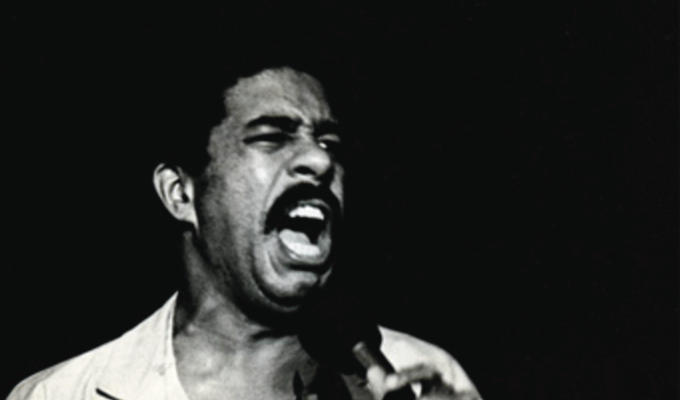
Richard Pryor he sees as an ‘hilarious sufferer… both shabby and heroic, both awful and innocent…’ a duality he links to tales of biblical underdogs. Later, he likens (not entirely convincingly) the gnomic one-liners of Stephen Wright or Mitch Hedberg to the wisdom of ancient sages.
The book is essentially a series of chapter-sized biographies of saints and sinners, weaving them into his premise. Crawford starts with St Francis of Assisi, a man he dubs the patron saint of laughter (although that honour actually belongs to 16th Century Italian priest Philip Neri).
The portrait here is of a genuine eccentric. There are tales of him rubbing ash on his head and insisting: ‘I am an prayer book’, stripping naked in front of a bishop or addressing worms by the honorific ‘Brother Worm.’ No wonder he instructed his first followers to go out into the world and be ‘the minstrels of the Lord’ – aping the language of 1 Corinthians, which describes the apostles as ‘fools for Christ’s sake’.
Ancient texts ‘tend to think’ Christian martyrs are funny, Crawford asserts. Their deaths in gladiator-style arenas are certainly staged for entertainment value. Some of them, such as the bishop Polycarp, play up to the crowds, subverting their sham trials ‘like Groucho Marx wrecking a meeting of state’. The priest Sharbel, still alive despite tortures that should have killed him, is likened to Monty Python’s ever-bellicose Black Knight.
The original Holy Fool, Symeon is dubbed the craziest man in Emesea – modern-day Homs in Syria. He’d prance into churches with sausages around his neck, shit in the marketplace and throw nuts at worshipers in what Crawford sees as a precursor to disruptors such as Andy Kaufman and Sacha Baron Cohen. Yet Symeon is also credited as being insightful, a man who ‘brought secrets to light’ as he taunted and teased. Crawford doesn’t say so, but that sounds almost like crowd work.
As a bridge between the ancient saints and the modern comedians, the story of Snuff The Clown reinventing comedy at the turn of the 17th Century is enlightening. He was a man who brought physical chaos and unpredictably to a London stage more used to formulaic comedy characters. It may remind older British readers of how the charismatic madness of alternative cabaret swept aside the pat mother-in-law-style jokes of the 1970s scene. Snuff, real name Robert Armin, replaced Will Kempe as the fool in Shakespeare’s company The Lord Chamberlain's Men, and his groundbreaking style can be detected in the Bard’s later plays.
Read as an account of some of the glorious eccentrics in history, God’s Fools is a treat - even if the links to modern comedy are overegged.
• God’s Fools: Laughing Saints, Delirious Prophets, and the Sacred Makers of Comedy is published by Applause. It is available from Amazon priced £25.98 in hardback – or from uk.bookshop.org, below, which supports independent bookstores.
Published: 5 Jun 2026


