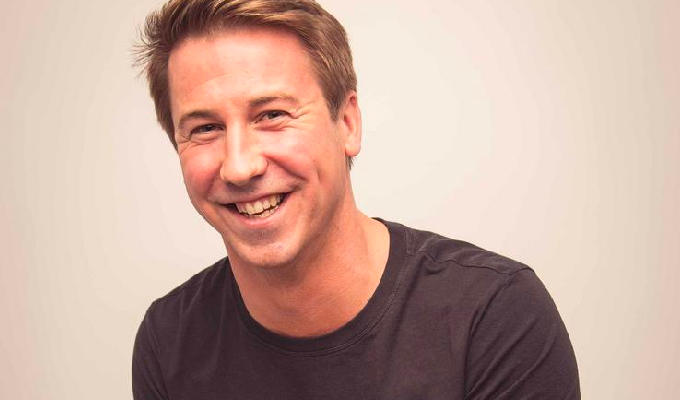

'Yes, this probably is the end of Ghosts'
Laurence Rickard on the sitcom's film adaptation, writing on Amandaland and more...
Laurence Rickard wrote Ghosts with Mathew Baynton, Simon Farnaby, Martha Howe-Douglas, Jim Howick and Ben Willbond, the team that first began working together on Horrible Histories and went on to create Yonderland and the Shakespeare comedy film Bill. The six also starred in the BBC sitcom about a haunted mansion – whose film spin-off The Possession of Button House, hits cinemas on October 23. He also writes on and appears in Amandaland, all of which he discusses with JAY RICHARDSON...
Are you working on the Amandaland Christmas special just now?
We're shooting that then we go straight into post-production, around the release of the Ghosts film. Then we begin work on the Amandaland series. Thankfully, there's a little bit of time while Holly [Walsh] is directing the Christmas special for us to attend film screenings. So it's worked out quite well.
Ghosts went out on a Christmas high in 2023. Does it feel like a risk coming back with a film?
Yeah, I mean, it's terrifying. We really ummed and ahed about whether to draw a line under the show. There was an offer there [from the BBC] to do another couple of series. We loved doing it so much but it felt like we'd covered all of the ghosts' backstories.
A couple of times in series five, we started talking about ideas for storylines that suddenly felt familiar. A bit like those in series one or two. So we felt comfortable we'd done the right thing by leaving it. But the producers have always softly gone, 'There's always a film …'. We'd just always felt there was such a danger of it feeling like a 90-minute television episode. If you're going to do that, why not just do another series?
Eventually though, we sat down one morning, reasoned that if we still felt like that by lunchtime then the question would be answered. But within about 20 minutes we'd hit on this idea. And suddenly everyone was really animated. We were genuinely excited to come back and do something on a bigger canvas.
Sticking your head above the parapet again is always scary. So it's a funny time. Really exciting but equally, we're all slightly chewing our nails.
Did you learn much from making Bill, where your distribution and marketing collapsed just before it was released?
The first thing we learned is that, in as far as you possibly can, you have to absolutely tie down distribution. It was a joy making that film. But there was so much trickiness that came afterwards.
We've been really lucky with [producers] Monumental this time, they managed to put together a deal that meant all of the finance would come through different parts of the BBC and Lionsgate took it for distribution. But yeah, we were really keen to have an idea of what the release would look like signed off before we got into it this time.
The cliché of sitcoms being turned into films is that the characters usually go on holiday. But you're inextricably tied to Button House. Was the possession storyline the best way that you could resolve that?
We wanted to use the broader canvas. But at the same time, so much of the show's comedy is with these very dissimilar characters from different generations of history thrown together, so the house feels as much of a character. We wanted to keep that element but in some way open it up.
And for the ghosts, having been contained for so long, the equivalent of the big holiday, let's-all-go-to-the-Bahamas idea is just being able to go down the road, celebrating being slightly freed of the physical constraints that they've been saddled with for hundreds of years. The possibility of a huge adventure for them without it being The Ghosts Go To France or anything that would feel like jumping the shark.
Hopefully, we've got to have our cake and eat it. There are elements within the film which will feel very familiar to fans of the show. And then there are elements we would never have done in the TV version, allowing us to be more cinematic with how it was realised.
You have these parallels of found families in the film. What was it like writing the younger characters?
It was great, really freeing. Anytime you bring a new character in, it comes with new challenges. Particularly, people of our generation writing for a younger generation. It's so easy for that to feel really inauthentic. Thankfully, the kids were really helpful. Quite early on we said to them, 'if there's something where you think "I would never say that", please tell us'. They were massively helpful.
When we were shooting it was so rewarding to have our little gang. And that's why we keep coming back to do stuff together. It's such good fun to be around them.
But the kids had that as well. They became a gang who all hung out and went out to dinner too. In the same way that the ghosts are a bit of a found family, it felt like the kids had this lovely experience as young actors filming. They weren't the only kid injected into this otherwise adult cast, they had peers.
In terms of the characters, feeling like they were found family, coming from slightly dysfunctional backgrounds, that's a challenge. But a really fun challenge to write for.
As you personally experienced with Amandaland, did you relate to Scott Ellis Watson coming into a successful show with an established cast?
We've all been that person on a show where you come in on your first day and it's daunting because everyone knows each other. Whenever new people joined the crew, or we've had guest characters, we've tried to be as warm and welcoming as we can. To try and make people feel like they were joining the gang.
We were super-aware of that from really early on. There were always some of us at all of the kids' auditions. From day one, they were all meeting us and working with us.
And as soon as we were all able to rehearse, the six of us and all of them together in a room, we just had a really good laugh, trying to make it as free as it could be within the constraints of schedule and budget. To make it a fun experience as well as, hopefully, a good film.
Did you have the likes of Rufus Jones, Sian Clifford and Joe Wilkinson in mind when you when you wrote their parts?
Always, really early when you start writing together, you might be two or three lines in when someone goes: 'You know who this character's a bit like?' And someone just goes 'Rufus, yeah'. And obviously, we've all known Rufus for years, he was in Bill with us.
Coming off the back of the show being so well received, when we thought of these names, we could go to them, they'd come back and say, 'yeah, great, we'll do it!'
We're at the point where there are performers we like but have never worked with, people we've worked with and know are great, where we're able to say 'would you like to come and do this part in the film, it's only a day or seven lines?' Everyone was just so up for coming in and having a bit of fun for a few days. We got really lucky with all the casting.
Was writing the film markedly different to writing the series?
Yeah. Normally, we always start together. Sit around the table, beat things out and try to get to the point of having a story document. Then we split up, write various episodes, come back together again and do a polish on it. But on this, because it was only going to be one thing, we sat down and storylined it together, talked about jokes and beat it all out. Then, when it came to the point of writing the script, that bit of the process was so much fun.
We were like, ‘why don't we just jump on a Zoom tomorrow and we'll take a look at the first scene?’ Whoever's about can jump on that call and whoever's not, that's fine. We leapfrogged each other. Some days it'd be four or five of us. Some days just two. By the time we were a couple of weeks in, it felt like it worked. And it also meant if someone couldn't make it for a couple of days, they'd come back in with fresh eyes and could give notes.
Because we've worked together for so long, we were laughing a lot. But we can also be quite honest with each other. It's a process that with six strangers would have been really painful. But it happened quite organically and was quite efficient, surprisingly.
You've said that you're all quite different people and only share a sense of humour. How would you define it?
Matt put it well really early on, I think around Yonderland. It felt like we were the naughtiest kids in class and that means there's a slightly acerbic edge to us. We're always slightly pushing at the boundaries of what you can do for a family audience but never going too far. We're a good tone check for each other. Every now and then you'll pitch something. And if another couple of people go, 'yeah, I'm not sure about that', then you know that you've stepped slightly over the line.
So I think it's slightly acerbic, slightly anarchic. But never to the point where you would be alienating the audience that the show has found, the holy grail of people watching it with their kids. We've had so many reports of multi-generational watching that we hope to carry that through to the film. That's our natural tone when we're working together.
Was that multi-generational aim born from you coming together on Horrible Histories, a children's show?
In part it probably is that, wanting to feel quite light, anarchic and slightly anti-Establishment, in the same way that [Terry Deary's Horrible Histories] books are. That helped.
But also, when we went in to pitch Ghosts, BBC Comedy normally gets pitched edgy, 10 o'clock BBC Two shows. And they were really looking for something pre-watershed BBC One. There's a sense that they go into meetings with their crowbars out, going 'can you give us the thing we're looking for rather than the thing you want to make?' So the fact that we could go in with something with broad appeal, slightly pre-watershed, they put their crowbars back in the desk.
We'd already found and were comfortable with that tone, we were giving them what they were looking for. We designed it to be a sitcom like the sitcoms I watched when I was kid, when I'd sit down and watch Blackadder with my parents.
Comedy got slightly ghettoised in the late 1990s, early 2000s when it fragmented into edgy, sweary things for adults and lots of kids shows. We were trying to blur that line a bit. And thankfully, the audience it has found were split quite equally between kids, adults and young adults. People who'd watched Horrible Histories and 15 years later are in their late 20s, still watching us.
People also bring their parents to it. At the coffee shop this morning a lovely older lady came over and told me how much she enjoys Ghosts. That's great.
How are you feeling about television comedy and BBC comedy in particular given the number of cutbacks recently?
It's an interesting time. You want to blame someone but there's no one to blame. The way that advertising works has changed, there's been an effort to make people's feelings about the licence fee change. Certainly, the way that people think about the BBC has changed and there's such a fragmented media landscape. So many channels, plus YouTube and socials. Everything gets a smaller audience share, which ultimately affects revenue, budgets and schedules.
In my career, it's always been tight. We missed the generation where there was endless money in television comedy. But it feels like it's getting tighter and tighter still. The hope is always that there's enough time, money and willingness to make comedy work and that people are happy to work within constraints to find something that's got broad appeal while you can still realistically make it.
The worry is that, increasingly, it feels like you're getting to a point where budgets and schedules mean the compromises are too much. That you can no longer make a version of the thing that you wanted to make, that you have to make something different.
That said, with Ghosts, with Amandaland, with other shows like Here We Go, with Ludwig, there are still audiences out there, big audiences. So it's not like it's a genre that's dying. It's just the fight to make these shows is a little more difficult. There's definitely hope for comedy, even if it's a slightly scary time. You don't want to be writing for a spreadsheet or a tariff.
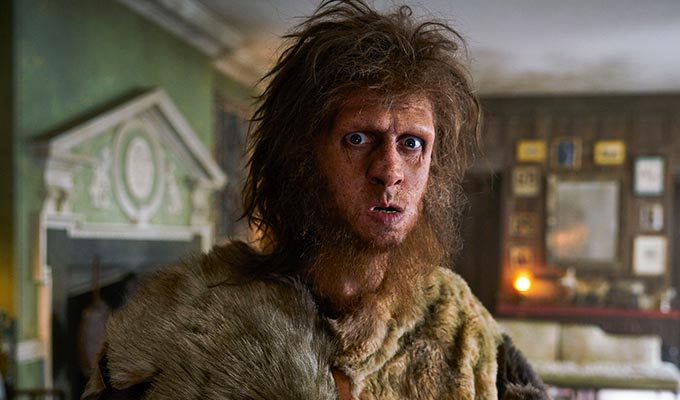
Do you enjoy playing Robin and Humphrey with all the prosthetics and the admin of two roles?
Yeah, I absolutely love doing it. Initially, when we made the 15-minute, non-broadcast taster, the plan was there would be hundreds of ghosts, all played by us, so we would all be multi-character. We felt that we shouldn't just have ghosts from that classic period of haunting, from the Tudors to World War II. But also someone from 1994. And equally, someone from thousands of years ago.
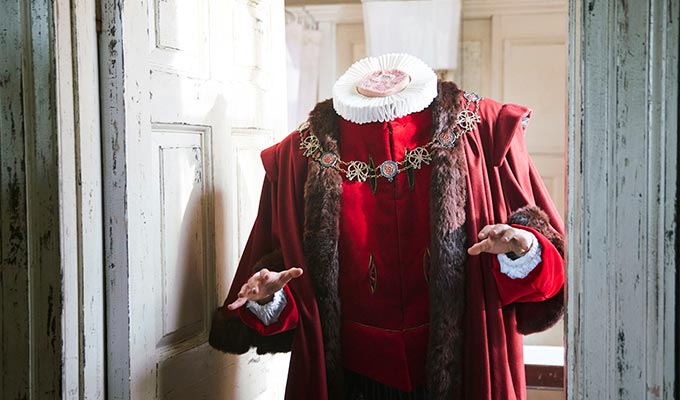
Obviously, someone said 'OK, who's going to play the caveman? Because that's a lot of early starts.' And I was happy to do it as long as I wasn't doing it every day. The thinking in the initial script was that Humphrey, or Headless John as he was then, would be my main character. And every now and then Robin would be this little cameo part that we would use to do jokes with.
Then we made the pilot. And it was clear that Humphrey as a concept was funniest when he was a separate head and body who can't find each other. And that means there's only so much of him you can use because he's a static object. And every bit of Robin we thought 'that's really fun, we should do more of that'. So it slightly happened by accident that the amount of each character I played switched over. And the fact I was playing both was a hangover from the multi-character idea.
Robin is such fun to play that I was always up for it. A lot of the guys wouldn't be keen on the long make-up process. Whereas I've always been quite into special effects and prosthetics, I quite like looking at it each day and working out how you refine it, shaving a minute or two off here or there, working out what makes the brows move easier. Trying to find the perfect version of it is rewarding and a very easy way of getting into character. It's so different from me that as soon as all the garb's on, I hold myself differently, it's very easy to speak differently. An easy shortcut.
Was there an upside to Katy Wix leaving the show in series four, in that you could further explore the ghosts' mortality?
Yeah, I suppose so. We knew how much stuff she had on, there was always a juggle with Katy in terms of her other projects and writing. So we knew it was coming. And thankfully, she had a lot of love for the show and we were able to come to this compromise where, rather than doing that thing that normally happens – someone does a series then doesn't come back for the next one - we were able to carve out a situation where she did half a series and we could take her out when the audience was least expecting it.
I think it was Matt who had the initial idea of how you would build an episode to the point where Mary disappeared. From the beginning, we said you either pass over or you don't, there's no rhyme or reason to it. We didn't fall into the trap of somebody doing a good thing, their soul was at rest and then they disappeared. We never wanted it to be as cut and dried as that. So Matt was like, if that's the lore, you never know when it's going to happen. It should just happen. Open an episode and she just goes. Which is how loss happens a lot of the time, just leaving you to deal with it.
Having the show explore that was really interesting in a way that we probably wouldn't have explored if we hadn't been slightly pushed into that corner. So many people have spoken to us about that episode, who genuinely felt it helped them deal a bit with grief.
That's something the show did generally. When people think of those who aren't with them anymore, rather than thinking about ghosts, spirits and the next realm or whatever it is being dark, spooky and horrible, they think instead of loved ones laughing, being together and having a good time. That the next level might be something other than a dark, endless void, a comfort. Which is something we never really thought of going into it.
It must have felt like a privilege with both Ghosts and Yonderland, knowing in advance they were ending and being able to plot accordingly?
Yeah, we've been so, so lucky on that front. When Horrible Histories initially came to an end, obviously it came back and continued to be very successful. But it felt like it was the right time for us with Yonderland. That was really lovely, a shake hands, hasn't this been a wonderful adventure thing? Both the channel and us felt it was the right time.
And with Ghosts, the trajectory of everything in television, you never know where the top of the mountain is. You're always thinking there's a higher peak so you keep holding off and holding off, and then there's the danger of it suddenly being over.
So I think being able to have the strength or foolishness, depending on how you look at it, to go out when we did, end it on our terms, was really lucky. So far, we've been fortunate in that we've not been in a position where we've had to be shoved aside.
What have you made of Ghosts' international adaptations? And does the executive producer money from those mean you're free to work solely on passion projects?
We're assured that money's coming at some point! With all these things, it's a shape with a very long tail. But we're still quite close to the body. We try to see as many of the pilots as we can and they're always interesting. Some we understand a little less of what's going on than others.
With the American one coming first, talking with the showrunners Joe [Port] and Joe [Wiseman], there was a sense that they needed to do something more culturally American and tonally more of an American studio sitcom, yet where the essential DNA is what we did. And I think they delivered exactly that. Once it was up and running, we could tell that it worked, we were very conscious of not wading in too much. It would have been very easy to note it to death. But we just told them what we'd have done making our version.
You know, ours exists, theirs exists and it's different but also really good. They do things we wouldn't have thought of. And for my money, it's a show that really came into its own when they started writing their own episodes. Rather than stories based on ours. It's got its own life now and the longevity has been amazing.
Something that's unique about the format is that everyone gets to impress a bit of their country's history and a bit of their culture on it. And that's always a really natural fit, they never have to shoehorn that in. So they're all the same and at the same time, very different.
The comedic tone is different too, they know what lands in a particular territory. So ours is different from America, from Australia, from France. It's always fascinating. And at some point, they're all very slowly writing us a cheque.
So is this truly the end of Ghosts now? And do you have your next group project in mind?
I don't know. I'll say yes, this probably is the end of Ghosts. But I've said that before. Thanks to the prosthetics, my character's slightly more forgiving in terms of the ageing process. But I know a couple of the guys are going, 'can I still pull off 28?' The ghosts don't age. But we do.
In terms of other projects, if this film becomes the next Avatar, then we'll probably do another. But we're all up for doing something else, whether it's a film, TV, there's various ideas we've knocked around. Nothing concrete at the moment. But I'll be very surprised if there wasn't something else. For all the constraints of making a British comedy film, it was such a fun process and so lovely being back with the guys again.
Is anything happening with In Case of Emergency, the hospital-set animation that you and Ben were developing for Netflix?
We thought it was dead but it may have another life. We've put the [defibrillator] paddles on it, fittingly. We might be doing something slightly different with it. But there's only so much I can say at the moment.
And We Are Not Alone, the sci-fi comedy that the pair of you created for Dave. There was talk of that having an American remake ...
Yeah, there are still various things alive on that front as well. With the film, we started filming in March. Between shooting, then edit, post and then up to release in order to hit Halloween, which we were all very keen to do, it's been quite an intense process. A number of things have slid on to the back-burner. But there are still some interesting possibilities, we'll have to see what shakes down.
And finally, you've written several Christmas specials with Ghosts, Amandaland and Bad Tidings, starring Lee Mack and Chris McCausland. What makes a good one?
I always think heart. Amandaland's fascinating because Amanda as a character is such a monster in a lot of ways and there's a lot of deliberate cynicism within it. But testament to Lucy [Punch] and the rest of the cast, even when they're doing slightly monstrous things, you always root for them and there is a slightly buried warmth that comes out at Christmas. And it's the same with the Ghost specials as well. Those had moments where you let the chinks of warmth be a little wider and a little brighter.
And particularly with the one we're creating at the moment. There's a very cynical move at play but it ultimately finds a way to be about love and warmth in a way that you can only get away with at Christmas, that might feel slightly cloying within a series. You always get that licence. It was there between Joanna [Lumley] and Jennifer [Saunders] at the end of the last special, the audience's cynicism slightly drains away.
• Ghosts: The Possession of Button House hits cinemas on October 23.
Published: 14 Oct 2026