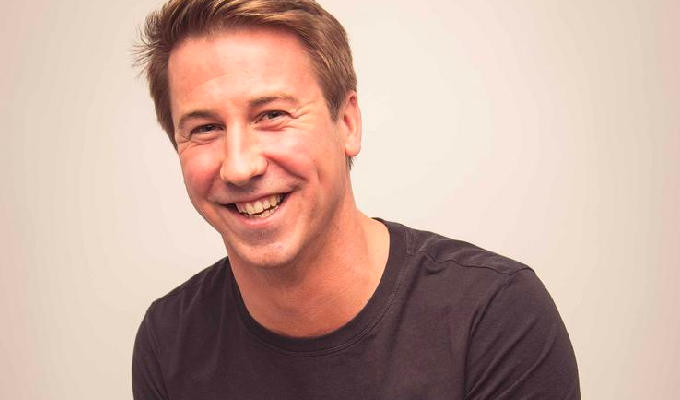

'A really polished comedian will get reamed in the UK'
The Big Interview: Rich Hall talks to Jay Richardson
Rich Hall started out as a street performer before finding stand-up and winning an Emmy as a writer and performer on the original David Letterman Show. Working on the show Not Necessarily The News, he coined the term 'sniglet' to describe newly created words and published five books of them, at the same time as becoming a regular on Saturday Night Live from 1984-1985. He won the Perrier Award in 2000 in the guise of his jailbird alter-ego Otis Lee Crenshaw and subsequently made a series of documentaries for BBC Four about America. Hall published his memoir, Nailing It, in 2022 and is currently touring the UK with the show Chin Music.
Have you changed much for this leg of the tour since Andy Burnham became Prime Minister?
My show is ever-changing. I'm always throwing something out, trying something new. By the end of a particular leg it's definitely not the same, especially the music or anything referencing Trump World. That's ever-evolving with a shelf life of about a day. Any Trump joke is good for perhaps 18 hours before his next outrage.
Dara O Briain's said it's tougher joking about Trump 2.0, things are darker this time around. Have you found that?
Not really. I have genuine disgust for the man, his administration and the people who support him. Late-night comedy in America has no bite to it. It's so toothless because he's a constant source of material but it's very low-hanging fruit.
I don't dwell on what he's said today or yesterday, I try to broaden the implications of what it means for Brits, Australians or wherever I am, how it affects them. Otherwise, it's not interesting. Most British people are completely disgusted by the guy too so they're already on my side. And you don't gain anything from preaching to the converted.
Do you lament the slow death of American late-night shows?
They've definitely had their time. There are too many of them when very few people still watch regular TV. As a comedian, it's a great challenge to go on those shows, they're a great credit to have. But it doesn't have the impact it used to. Which might be a good thing. A lot of comics went on those shows, did well, but couldn't deliver live. Same with Live At The Apollo.
Now, having a big online presence is the way to make an impact. The saving grace for real stand-up is that you still have to go out on stage. Maintain that pure relationship with the audience, even if you've got millions of hits for your crowd work. That's the one thing I don't see changing. It's like music, you've gotta keep proving it.
Do you see yourself endlessly touring?
Possibly, yeah. It's the one thing I really love. And the most stable thing as a comedian. I've got all day to be thinking about stuff. And I'm never afraid to try it out that night with a new crowd because if it doesn't work, I know how to tunnel out from underneath it.
I'm definitely playing some out-of-the-way places now, where I'm clearly the only entertainment game in town that evening. You don't have to do that much work. But you need to pay attention to where you are, make light of the place, so they know you're not just phoning it in.
Are you still committed to doing topical stand-up in the first half, songs in the second?
It's very effective. I enjoy the second halves because my tour manager is also my guitarist and plays about six different instruments. It's very important to me to not just crank out pedestrian songs, but make them as musical as possible.
That's something I learned from Boothby Graffoe. He said to me, 'man, you've got to learn to finish some of these'. Because I used to stop once I got the laughs. I've really started concentrating on fully-formed songs that don't always end on a big laugh. If the idea itself is funny, then it doesn't have to. People stay with you.
Had your father encouraged your early interest in music, do you think that's what you would have ended up doing? Or would comedy still have got you at some point?
I always wanted to be a musician. But no, I didn't have that encouragement and I was intimidated by instruments.
But the main reason I became a comedian, my epiphany, was seeing Tom Waits. His songs were brilliant. But his intros and persona were just hilarious, he blew me away.
And this was a time when comedy was really starting to take off into the stratosphere, with Steve Martin, George Carlin. Comedy was becoming an arena event, which it never really had been before. I happened to pick the right time to start and found the right inspiration. I was Tom Waits without music.
Do you think good comedy songs are an underappreciated artform?
They have a slightly longer shelf life than good stand-up. It gets in your ear. I used to hate musical acts because the majority of them were doing sub-Weird Al [Yankovic] parodies. He's great, he's the king of musical parody and does it as well as it can be done. But it's really easy to take an earworm song and change the lyrics, every hack in the world can do that. You lose respect for the audience laughing when it's just reworked lyrics to American Pie. For fuck's sake, do something original.
When I first started doing musical comedy, I knew I was limited on the piano. So I invented a character [Otis Lee Crenshaw] that didn't have to be that good. And made sure I was backed by competent musicians. Otis was the first time I thought I could make music. I had the ideas, I just needed the chops. That was one of the best decisions I ever made. I got tired of doing him. But I knew I wanted to continue making music, so I still do.
The film based on your Otis novel, I Blame Society, how close did that come to happening? With Mel Smith directing?
Like most scripts it just sat there for a while, then everyone moved on. That's the nature of filmmaking.
Character comedy, playwriting, documentaries … have you always been keen to try different things?
Yeah, if the opportunities are there. To be honest, I never thought of them as documentaries because they're so scripted. A true documentary sets out to discover. And I already knew what I wanted to say. Things came along while we were shooting, I always did the research. But they took longer to write than film. It was a period when BBC Four had some money, they were experimenting and asked if I wanted to do something about America. There's plenty of stuff I'm interested in, so I delivered these opinionated monologues. They're scripted lectures.
After making Rich Hall's Fishing Show with Mike Wilmot for the BBC in the early 2000s, how do you feel about Mortimer and Whitehouse stealing your thunder?
I really like that show but then I like every fishing show. It was great to interview people in a boat. When you're on a lake or river there's a lot of downtime. And it just struck me that we should make a fishing show where we never actually caught anything. That's funny. We had to fill up the time with bullshit. Mike and I stayed up all night writing stuff for the next day. A lot was shot in Scotland and it was spectacular. For some reason it never rained that summer, every day was gorgeous.
You were a stalwart of Channel 4's Stand-Up For The Week in the 2010s. With Live At The Apollo finishing, do you think the main channels need a new stand-up showcase?
At one point Live At The Apollo was putting on the best comedians out there, the producers knew who they wanted. And then the viewerships started to dwindle. Maybe the idea of tuning in to see who was on just ran its course. That's the nature of every show that's ever been on television. There's still a strong platform in terms of Netflix specials. But I'm not sure about bringing six people out to be funny for eight minutes apiece, I don't know if that could be replicated now or if it's still viable. That's not to say the comedians aren't out there though.
In Nailing It, after your Edinburgh Fringe debut, you say that you'd spent the last 17 years doing the right comedy to the wrong people [in the US]. Have you always been better suited to UK audiences?
So a couple of weeks ago, I finished up in Edinburgh on a Sunday night and it was great, good crowds. I've begun to notice younger people dropping their parents off to see me. Then on Monday, I walked out at the Horseshoe Casino in Las Vegas and immediately knew I had to do some refinement. Just because they were dumber. In Edinburgh I'd done this routine about self-driving Waymo cars and in America I had to throw in more information before I got to the joke.
I don't know why. I'm not saying Americans are dumber than Brits because they're not. But the sense of humour… it's weird because most of the best comedians on the planet are American. But your basic, everyday crowds showing up in Vegas are pretty lacklustre. I had to take it down a notch. That was a stark difference in 24 hours.
You've said 'Americans want comedy that's packaged and apportioned. They want the veneer, the manufactured persona. Brits want to see the human behind the jokes’…
Absolutely. Slickness is anathema in this country. A really polished comedian will get reamed by critics and the audience. They suspect you're doing it by rote. And they want to know the mistakes behind it, they want you out on a limb or just being a bit more human. I think British comics engage the audience a bit more.
Americans quite often come out and just do what they've written. They've really, really worked on it. Larry Miller, he's better known for his acting but his stand-up was spectacular. I used to go over to his house, help him write and he would stand in front of the mirror, work out every gesture. And when you saw the routine, it was perfection. I don't want to be like that at all. But I admire the effort, he was a great storyteller, a great wordsmith.
Audiences here are a bit circumspect about that. Brits are also way more prone to being sly and sarcastic in everyday conversation. As a deflection, there are some zingers in there. My [English] wife jokes to Americans and they take everything more at face value, there's less piss-taking. Brits and Australians aren't afraid to belittle and make fun of themselves, embrace the darker and sarcastic.
You're often credited with the idea that it takes stand-ups 10 years to find their own voice. In Nailing It, you despair about the professionalism and homogeneity of modern stand-up. But do you sympathise with modern comics that they don't have as much time or chance to experiment?
Comedians don't know how good they can be when they start out. They come off saying: 'Man, that was great. I just killed'. And they're not thinking five years from now how they're going to grow as an artist, a creator, a performer and a writer.
I don't think you could even have the foresight to imagine what you'll be like in five years. I mean, most comics are just trying to reach the point where they're making a living. That's a huge milestone, supporting yourself. Jerry Seinfeld likes to say that the first time you go on stage and do stand-up, you can call yourself a stand-up. I never agreed with that. The first time a baby walks, technically they're a pedestrian. But they're not.
When you were performing in New York alongside people like Seinfeld and Elayne Boosler, there was also Andy Kaufman. Did it feel like an experimental time?
Yeah, you could experiment more. There were templates in place from established stand-ups. Jerry Seinfeld was already established by the time I hit New York, already the best comic in town. There were three major clubs in Manhattan alone and you could do six 20-minute sets on a Saturday night if you raced between them. Doing sets over and over, you could get really polished and learn a lot quickly.
But by your third or fourth set, you just wanted to come out and goof around. Or maybe you were doing stuff really late at night. I played the Improv a lot. And at the point where Gilbert Gottfried came on, usually after midnight, that's when there were all kinds. It just got crazier and crazier into the night. 'We're not putting this guy on at 7pm, we're putting him on at 11pm because he's out of his mind'. But it worked and it was great. Some in the audience were coming in at 8pm and staying until 2am, watching six hours of comedy. And the show wasn't over until the last table left. So there was all kinds of stuff going on.
I can imagine ...
But that doesn't mean that Seinfeld, Larry Miller, someone like that, didn't know the route to commercial success. When The Tonight Show or Letterman people came in to watch, everybody stopped fucking around and did their A material. It changed the whole atmosphere in the room. You could walk in and tell. The staff would urge you to do your best stuff. It made for a perilous atmosphere because you had to win the audience over. But you were really auditioning for the guy in the back who might recommend you.
I always enjoyed that tension, you never knew what you were walking into. You'd often get bumped if someone like Rodney Dangerfield, David Brenner, Robert Klein or George Carlin came in. They were going to do whatever and however long they wanted. And you might have to go on right after them. That was tough.
When I moved to Los Angeles, I remember seeing Richard Pryor come into The Comedy Store one night, he came in and just did three minutes. Maybe one joke, one idea. The next night he'd do five minutes. And within a month it was an hour. Astounding to watch.
You didn't think Larry David had a future in comedy?
Larry David was the first example I can recall of a phenomenon I'm seeing now a lot. A guy or girl may have got something but they haven't connected with the audience yet. And Seinfeld obviously saw it because he was very influential in making sure Larry finally found his audience.
When I see Larry now, I can't picture him young. He always seemed like a perpetually old guy on stage. He had the kind of persona that left the audience confused, he seemed so angry and neurotic. But all the comics at the back of the room were laughing. It was the same with Richard Lewis, the average Saturday night crowd, they didn't know what to make of him. They were comics' comics that seemed like they needed a therapist rather than the stage.
You could sense Larry David was hilarious. He just couldn't broadcast his comedy. He was a writer on Saturday Night Live when I was there and famously never got a single sketch on. And that whole [Seinfeld episode where George Costanza quits his job but then comes back to work] actually happened.
He quit on a Saturday night after dress rehearsal, screaming at the producers, screaming at everyone, telling them to go fuck themselves. Then I guess he had Sunday to reconsider. So he just showed up for work again on Monday. And everybody, even the producer, Dick Ebersol, just went, I guess he got it out of his system. He just pretended it never happened until everyone accepted he was back. And he still never got a sketch on for the entire year.
His sketches worked great in the read-through, the cast would be howling. But he couldn't get anyone to act out his type of humour and make it work. So they always got killed in dress rehearsal. Which is why he quit that night.
You've called SNL the most difficult show you ever worked on. Did it improve you as a writer?
We didn't have enough time. We all knew we were only there for a year and it probably takes three to figure out how to make it it work. It was a crazy format. I haven't seen much of the British version but I've watched sketches on YouTube. And I was delighted to see it's really good.
If you'd asked me beforehand if I thought it was going to work I'd have said no. Because I knew how that show is put together and I've never seen a British comedy writing team work the way Saturday Night Live, or most shows in America, work.
Here, people go for a meeting, go home and write. Whereas in America, you go into an office, kick around ideas and spitball with other writers. Until, eventually, you've got a show. I imagine they're there all day and sometimes all night to get that show ready for Saturday.
Your cast was incredible. Billy Crystal, Martin Short, Julia Louis-Dreyfus, Christopher Guest, Harry Shearer, Jim Belushi ...
Yeah, but that was sort of a plug-in year where they'd been thinking about cancelling SNL and then Lorne Michaels announced he would return. He'd been up in Canada doing a primetime show with John Candy that didn't really work, decided he was coming back but needed a year to finish up there. He'd already said he was going to clean house. We got hired as an interim cast because the producer, kind of an idiot, hand-picked the people he wanted on.
SNL has always been a discovery platform. But that year it went all-star. Billy Crystal and Martin Short were already established. Jim Belushi was known, as were Harry Shearer and Chris Guest because Spinal Tap had already come out. And I was working on another show, Not Necessarily The News [The US adaptation of Not The Nine O'Clock News]. I never had to audition, I just got an offer. Every other year has involved auditioning. So we only got to do it for a short time. But it was a great year and the ratings went way back up.
Mentioning Not Necessarily The News, do audiences still shout 'Sniglets' at you?
No, that's all in the past. That was one of the reasons I came to Britain. It was kind of a golden albatross hung round my neck. They never worked on stage. I tried but they just weren't as effective as the other stand-up I was doing. But that didn't stop unscrupulous club owners from using 'Sniglets guy' as a way to sell tickets. Coming to Edinburgh, not having to deal with that, was great.
You began as a street performer, baptising dogs and appearing as The Human Slinky. How formative was that for your later stand-up?
It made me fearless. I went to Philadelphia, then on to New York, and there were ready-made crowds for comedy. When I'd always had to build one before, get them together before I could even be funny. I'd only wanted to be on the street. But people told me I should go to New York or Los Angeles. By the time I got on stage, and I was going on really late at night, I didn't need a mic. There were only eight drunks in the audience anyway. It wasn't until they started moving me to earlier shows that I started using a microphone. But I still had a lot of props because you need them as a street act.
And you opened for Talking Heads at that time. What do you remember about that?
It was at the University of Maryland. I'd been there about a week doing four or six shows of 20 minutes a day. Every hour, students were crossing the commons to get to another class, I'd start up another show. And I'd built up a following. It was my second or third time coming back. And by then, people were showing up in advance. I was making bucketloads of money. And this student activities promoter introduced me to their manager.
The show went great because I was established on campus. So they were pretty receptive. Not so much the rest of the tour, I did six more dates. The next night I got shit thrown at me. It was awful.
Tell me about the time one of the surviving Charlie Hebdo cartoonists walked out of your show.
I'd hated speaking to this guy from the stage, I'd just thought he was annoying. I didn't want to hang out with him afterwards. But then he drew this cartoon on the napkin, I realised who he was and it was shocking.
Because it was still so burned into people's memories at that point. I think he was a guy who was very, very moved by his convictions after the shooting. I think he just felt that comedy had become really, really important. And for him, me playing music was me backing off from my own convictions.
I had to explain that I'm just as convicted about playing the musical part of my show as the political part. He wanted me to be way more passionate about what's going on in the world. Of course he did. God, he's seen some stuff. And I guess he believes, probably falsely, that comedy can change the world.
Maybe some of the other cartoonists said 'fuck it, I don't need this, I'll go draw illustrations for ads or whatever'. But this particular guy, it made him think that what he was doing was more important than ever. I certainly appreciate his personal convictions, it was a brutal moment of honesty.
I had something similar on the last tour. A woman came up to me and told me that she had appreciated everything I'd said about Trump.
Her son, [Harry Dunn], had been killed by an American driving on the wrong side of the road [Anne Sacoolas, leaving RAF Croughton]. She told me 'you were my son's favourite comedian'. I just about collapsed and went 'oh, man'.
The kid had a twin brother, he was at the show and that floored me too. There's this element to performing where you think of the audience as a whole. 'Well, that was a good crowd'. Or 'they weren't so good'. You don't really think about individuals and how you might be affecting them.
In both of those instances, someone conveyed to me what I'd said on stage meant to them. And you don't really want to deal with that a lot, you know? You just want to think they had a good time, move onto the next show. The reason we're comics is because some comedian affected us in a way that made us want to do it.
You famously inspired Moe Szyslak, The Simpsons' bartender. What kind of reactions did you receive when you went trick-or-treating as him with your son?
Not much because it was in London. And we only went to about eight houses. But then we went to the pub, met up with a bunch of friends and they thought the Moe get-up was hilarious.
Are you writing any more books or plays?
I'm in the middle of another book, on about my sixth rewrite. I haven't even tried to find a publisher. Books are the only merchandise I sell now because there's no point selling CDs. I'm not that interested in whether it gets into shops because I sell 70 books a show sometimes. And that's great, a pretty sizeable readership when you start adding it up.
It's about my dog being dognapped. I'm on the toilet with nothing to read, reading the laundry labels on my sweatpants in all these different languages. And one of them says: 'We have your dog'.
It becomes this very convoluted story about how the dog's been taken to Vietnam for a religion that worships Confucius, Jesus and Victor Hugo. Somehow, the leader of the religion makes his living writing laundry care labels. So I have to track my dog to Vietnam and get caught up in a cult. It gets crazier and crazier, a shaggy dog story. Except the dog isn't that shaggy.
Plays? Nope. I learned my lesson, they're very expensive to put on. I have to go back to the States for a Western movie involving a fight scene. I've always wanted to have a fight scene in a Western.
What's that about?
I've only read the scenes they've sent me. But it's about a guy who finds redemption through fly-fishing. I play this Norman Maclean-type character, the guy who wrote A River Runs Through It. He's a sort of fishing genius who ends up in the wrong place and in a fight. But he has a writerly approach to the whole thing, goes home and writes a story about what he went through. We'll see if I can pull it off.
So I'm not actively trying to do as many different things anymore. I'm 72 and incredibly thankful I'm still funny. I also still love stand-up comedy which is pretty astounding if you think about it. I aspire to be the Robert Plant of comedy.
Oh yeah?
He's taken me under his wing. For some reason, he loves my comedy. Anytime we're in the Midlands he comes along. And he showed up in Bozeman, Montana one time when I was on stage. Somehow, I keep in touch with him all the time. He's very grandfatherly. Not so rock 'n' roll now, he's hot cocoa. But still pretty attentive to where he is.
He came to this show I did in Missoula. And the next day went up on this reservation in Montana that has a history of taking Blackfoot kids and Catholicising them. Back in the 1920s and 30s they were forcing these kids to go to school and some of them died in mysterious circumstances. They just buried them in the back of the church. Somehow, Robert found out about this and asked to see the graves. They asked him to leave but he wouldn't
Eventually, the priest came out, went 'Oh my God, that's Robert Plant!', then went, 'OK, I can tell you this and this much I can show you'. They ended up giving him this big tour, just because he was the lead singer of Led Zeppelin. They were going to call the cops. Then suddenly it's like 'here's where the babies are buried'.<
...You live in Edinburgh?
Glasgow.
I'm doing about ten days in Scotland. Stewart Francis lives up there. He's kind of retired from stand-up.
He always wanted to be a cartoonist didn't he?
Yeah, he's starting to get some presence as a cartoonist. He came to my show the other night and we were talking afterwards. I asked: 'Don't you ever miss this at all?'
He said: 'No. I like seeing other comics but I dreaded going on stage every night. It was what worked but I never enjoyed it'.
Must be hard if you've got the talent but you hate it ...
It's the same with Mark Lamarr, who I see all the time. Loves to talk comedy. Would not remotely entertain the idea of doing it again. It's weird when someone's really good but they don't enjoy it. I can't fathom it..
Published: 18 Sep 2026