

'There's a power in choosing when to be vulnerable'
The Big Interview: Rosie Jones
Rosie Jones has just released her debut stand-up special, Triple Threat. During a busy 2025, she also toured a new show, I Can't Tell What She's Saying – which will be filmed at the Soho Theatre next year for future release – co-wrote and starred in the Channel 4 sitcom Pushers, about a ragtag band of disabled drug dealers; set up her own charity, The Rosie Jones Foundation, and hosted the Comedy Central gameshow Out Of Order, which returns for a Christmas special on December 22 ahead of a second series next year. Here she talks to JAY RICHARDSON about all of that...
You've just finished your most recent live tour. What are you working on now?
I'm writing my third Edie Eckhart novel for children. The deadline is this week! I'm proud of my kids books. And I love that I'm able to give kids the disability representation I needed growing up. TV-wise, everything works so slowly. I've got a few scripts on the go. I'm writing a drama, which is new territory for me. But I'm enjoying it. I don't want to say too much about it. But if we get to do that it would be excellent.
There's been quite a long gap between the Triple Threat tour and the special. In it you joke about hoping for an elderly national treasure to pass away – were you anxious that that might happen before the release?
All through the tour, I was thinking, "Oh my God, please don't die. And the special coming out made me even more nervous.
What kind of reaction has the special received?
Really great. Your debut special is a milestone for any stand-up. But I also wanted to make my comedy accessible for disabled people who probably find it more difficult to come to comedy clubs. My tours are accessible. But a lot of comedy clubs aren't to everyone. So it felt important to put out stand-up that everyone can watch.
It's available all over the world too… I’ve always fancied the US and Canada and I haven't been there yet.
Every UK performer talks about wanting to break America. It is my dream to go there one day. But with the political environment right now, I don't want to visit the US anytime soon. I just think it's absolutely heartbreaking what Trump is doing in terms of breaking down DEI and diversity. Because of him and his politics, I won't go.
Still, to give good people my comedy and say ‘look, I'm disabled, but that doesn't mean my voice should be any quieter or less valued than non-disabled people’, that's fantastic. I hope it gives disabled people in the US a bit of joy in quite sad and troubling times.
Alongside Billy Connolly and Victoria Wood, US stand-up Tig Notaro is one of your biggest inspirations isn't she?
She absolutely is. She's an inspiration on so many levels. For being an out, proud, queer person, and how she tackles tricky subjects like cancer. I often want to tackle hard-hitting subjects.
But also, a big eye-opener for me seeing Tig's stand-up was her style, her tone and speed. Years ago now, I remember watching one of her specials. Before that, my comedy intake was full of fast-talking comedians that I love but could not relate to. Tig talked very quietly and very slowly in a way that draws you in, makes you hang off every word.
The speed of my voice isn't a choice. But seeing her made me go: 'Oh, I can do that'. Without Tig, I wouldn't have had the confidence to start comedy.
She's adept at determining just how vulnerable to allow herself to be on stage as well. Is that something you think about a lot?
Definitely. And it's always an evolving process. When I started out, because people didn't know me, they often assumed I was vulnerable because I was disabled. I needed to come out and be top dog. I had to be like: 'Don't worry about me, I'm alright. Don't shit yourself. I'm a good, happy, independent person.'
But everyone is three-dimensional, everyone has layers. Over time, people have got to know me. They see me on TV. They see me live. So I now go into tour shows with the majority of the audience not feeling sorry for me because they know I'm a capable, independent woman. Which allows me to be more truthful.
I told a story in my last tour of the man who came up to me after a gig and said 'me and my friends, the lads, have a WhatsApp group where we mock you and we make fun of you. But actually, you're quite funny.’ A story like that, I wouldn't have told on stage ten years ago. Because I would have felt too exposed.
So yeah, it's now about working out if I am in an environment where I feel confident enough to be vulnerable. Because sometimes, when the audience doesn't have all of the information, it means I'm on the back foot and no longer in control of the show. There's a power in choosing when to be vulnerable.
Beyond the online abuse you've received, that situation must have been particularly unsettling. Your whereabouts on most nights are publicly available.
Yeah. And I think that's why I tell that story. Even nice people though, sometimes I meet them and they go: ‘Oh, you're amazing, you're formidable, you're fearless. You have an amazing life. You are living the dream'.
And while all of that is true, at times I think it's super-important as a disabled person with a platform to say ‘yes, but I worked hard on my happiness. On my mental health.’ I am in therapy to check in on what I need. Daily, I make sure that in every situation I feel safe and capable, every interaction I have I'm on my guard.
Because I'm not sure if that person will say something ableist or inappropriate.
Away from all that too, I don't ever want a disabled person to look at me, look at my career and go, 'she's always happy. Why am I not happy?' Life is so hard and I want to show everyone, including disabled people, that even though I work hard, have a great job, have a good life, the fact that I'm disabled makes me more vulnerable in this society.
We're getting better, sure. But it is still not OK. Showing vulnerability when I feel confident and assured that I will be safe is important. But it's a fact that being a disabled person in the UK right now makes me far more vulnerable than non-disabled people.
Your CV is varied, across comedy and activism. What do you attribute that to?
There's a number of things. The first and most boring is that the life of a stand-up comedian is very different to what it was 30 years ago. I can't make a living simply doing stand-up. The second is that I was a writer before I was a stand-up. So writing TV shows, my children's books, really felt like logical steps.
I also love how, even though they are different from my live work, they are still bits of comedy and I'm just making people laugh in a different form. That brings me pure joy. At the same time, as a person who never went to drama school, I pinch myself whenever I get the opportunity to act. Bringing disability representation to a world that needs to do better in terms of visibility. It gives me joy to bring these three-dimensional characters to life.
But the final thing, the most political, going on Question Time and running The Rosie Jones Foundation, that is my personality first and foremost. I've always cared about the world, I've always been super-political and very angry at times at the state of the country. As a disabled person I can see first-hand how we are left out of a lot of the conversations about us. So as a disabled person with a platform, I want to use it for good.
Being in an industry where I'm paid better than the average person, I was so conscious early on that I wanted to get my money every month, pay my rent, pay my bills and have a nice burger. And then everything else, money-wise, I don't need. So I've always been super-conscious about wanting to give it away and to help people. By creating this foundation that helps the mental health of people with cerebral palsy, I can see the positive impact I'm having in terms of being out there, giving money.
So yeah, when I sit down and go I'm a comedian, writer, author, founder of a foundation, I think, oh my God, that is way too much. Why have I done that to myself? But they've all happened so slowly and so organically that it's always, always made sense to me to just help and to do so many varied things.
Tell me more about the foundation. You had your first fundraising comedy gala last month didn't you?
We did! And it was a marvellous evening, we raised a lot of money. We're working with Disability Plus, who provide mental health support with a team where every counsellor, psychotherapist and psychologist is disabled. With the money raised we can provide hundreds of counselling sessions for people with cerebral palsy to see counsellors with cerebral palsy too.
We're aiming to have an annual fundraising gala, as well as organising community events for people with cerebral palsy throughout the year. Watch this space!
You've achieved the rare distinction of winning Celebrity Mastermind and coming last on Taskmaster. How did they accommodate you on the latter so that your participation wasn't restricted?
They were incredible. I've been a fan of the show for so long. The example I use whenever I'm talking about diversity and inclusion is that the first time I was driven to the famous house, I looked at the doorway and it had a new red railing on the front step. And I was like, 'yes!' Nobody else would notice it was there. But it's permanent. It brings me joy because that's there for every future contestant who needs it. And it looks great, like it's always been there.

Sometimes people are heavy-handed when it comes to disability, going: 'Make way, make way, there's a disabled lady, we're doing this! We're doing that! Aren't we good people?'
But for me, inclusion is first and foremost about having a conversation with the person involved. So Taskmaster came to me and said, 'Right, what do you need?' I told them. And then it's about doing it, getting on with it. But making it normal, not making a big song and dance about it. They've never mentioned the railing in my series or subsequent series. But everyone can see it's there just to make my life easier.
So I really hold Taskmaster up as a great example of a TV show where they didn't really change anything fundamental, we all did the same task. They just made it so I could take part in everything. They were amazing.
Pushers finished with an open ending. Are you working on a second series?
I can't say yet. But I will say that Pushers is probably the thing I've worked on that I'm proudest of. Not only from a creative and representative point-of-view. But how we had an access co-ordinator with us every day. The whole crew felt so valued and listened to and I'm proud of the environment that we created. And I would absolutely love to do more.
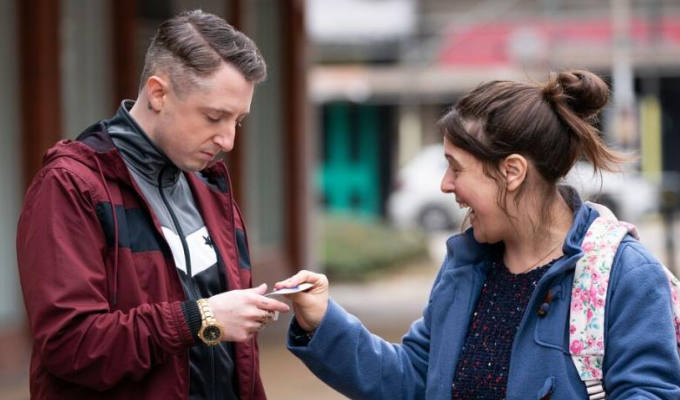
It felt like Emily was losing her love interest but gaining a nemesis ...
Yeah, that's it. We left it with Jo [Rhiannon Clements], my girlfriend, taking over her dad's drug empire. So that will be a lot of fun to play with in series two.
With Out Of Order, I understand that you had some initial reservations about the show's judgmental nature. How did you get past that?
I can't talk about this without sounding so arrogant. But to bang my own drum, I'm exactly the right host for it because it's about judging people. And with a male, non-disabled host for example, it could come across as way too harsh. But because I set the tone, and because I know more than most people about what it's like to be judged every day, everyone knows that I am never punching down. We are just having a lot of fun. Everyone's invited to the party.
Your Taskmaster jumpsuit featured 'Daddy' prominently written. It's a nickname that I first became aware of on your old podcast, Daddy Look At Me, with Helen Bauer. When and where did that persona originate?
We've gone full circle here. It came about early in my career when not a lot of people knew me. And I love playing with judgments. The idea that I would come on and some people would go 'Ah, bless her, she's so cute'. But no, I'm not a fucking victim. I'm Daddy.
I'm in charge. I'm a dom. I'm a sexual being and I'm in control. The nature of a 5ft 2in lady being Daddy, that's funny stuff.
Finally, what's the third Edie Eckhart novel going to be about?
It's a lot about Edie discovering who she is. It is for children. And it is funny. But I definitely felt this as a child, suddenly worrying about what adult you will be. It's 12-year-old Edie having an existential crisis.
Published: 16 Dec 2025


