How Dawn French made me cry
Interview with Simon Mayhew-Archer, writer of her new comedy, Can You Keep A Secret?
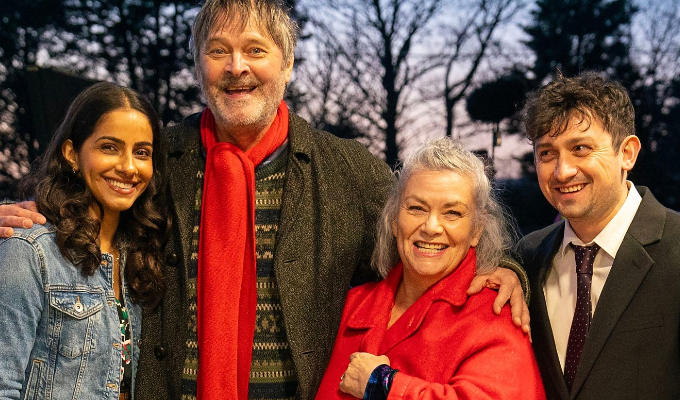
In the forthcoming BBC comedy series Can You Keep A Secret? Dawn French plays Debbie Fendon a ‘tinpot dictator’ who maintains the illusion that her husband William (Mark Heap) is dead, hiding him away in the loft for a few months until the life insurance pays out. The cast also features Craig Roberts as the couple’s son Harry, and Mandip Gill as his wife Neha. Here writer Simon Mayhew-Archer talks about French making him cry (in a good way), being inspired by his parents – including Vicar of Dibley writer Paul Mayhew-Archer – and how to create credible characters.
What would be your elevator pitch for the show?
I wanted to do a show that was both a sitcom, but also had enough of a mystery hook narrative that pulls you through. I looked at my life and I thought, my parents do really annoying things and I wonder if I can make a show out of how irritating I find what they do.DF
The elevator pitch for the show is: a man has a very tricky relationship with his mum and when the dad unexpectedly dies and the mum discovers that the son has been depressed, she decides to cheer him up by revealing that the dad didn't really die, he's been living in the loft, and they took the insurance money.
Did you always have Dawn French in mind?
Dawn was always earmarked as Debbie.
I grew up with Dawn being sort of one degree removed, through my dad..
It’s funny because you would think that that means that there's this great sort of historical close relationship, but actually, they were friendly and they were very professional and they had a great relationship, but my dad never really involved us that much.
So, I wrote it with Dawn very much in mind, and originally I wrote it on spec, and I was not expecting it to be any good. I still don't entirely trust that it is any good, but it's almost too late now because we're here.
I sent it to a few friends in the industry and I got better feedback than I was expecting. Then I sent it to my dad and I got much better feedback than I was expecting because he's usually really blunt and quite brutal. So my confidence was up.
I don't know why, I think I'd been listening to a self-help book about seizing the moment and not overthinking things and I just thought, fuck it, send it to Dawn. The worst she can say is no. And I did and she said that she was really busy and she couldn't read it for a few weeks, but she would take a look. Then she emailed me two days later and said she loved it. And I cried.
How would you describe the arc of the show?
I suppose there's an old quote about sitcom writing, which is that your job as the writer is to chase your character up a tree and hurl rocks at them. Whenever Debbie or Harry or Neha think they have solved the problem, they've created another bigger one. That's very much Debbie's MO, is that she is thoroughly convinced of how good her ideas are, and they pretty consistently turn out to be quite a bad decision. It just hopefully snowballs from there in an organic way.
I suppose the way the story unravels is that, if you asked Debbie, has she done anything wrong, she would be unequivocal in saying no. She has simply been presented with a set of circumstances, and she has chosen a certain path at each moment.

When William is mistakenly declared dead, that's not their fault. That's the mistake of the doctor. The fact they took the insurance money really is only a kind of a karmic rebalancing, because they've done all the right things through their life. They've played by the rules. They paid that insurance company all those years, and they didn't get a payout when he got Parkinson's so, to them, it's really only fair that they take their share now.
So, no matter what she does, Debbie is always on the right side. She's in the good and everybody else is in the bad.
Given the premise of the show, the stakes are high, but this is also a comedy. What is making us root for these characters that are doing morally transgressive things?
I think, hopefully one roots for the characters because they are only playing the cards that they've been dealt. They haven't gone out and done too much themselves. I guess there's some moral ambiguity about what you might do in that situation. I don't know what I'd do. Would I do insurance fraud? I might. I don't think I feel particularly sorry for insurance companies.
Despite the outlandish antics of the family, all of them are incredibly relatable and you can understand why everyone makes the choices they make (for the most part).
Finding the balance between relatability and outlandishness — that is the essence of comedy, because you have to do both. If you fall too far on one side or the other, you risk making something that's either so silly that it's not believable and you don't connect, or it's boring.
When you look at real life, there's a lot of mad people out there and so you've got to try and find a way to put those mad people on screen and give them a story that pulls you through and makes you want to watch, but at the same time is always still rooted in some sense of, 'I recognise this’. They're not just doing things to try and make me laugh. They're doing things because they really believe it's the right thing to do at this moment.
This story also is about an older couple who’ve been wronged by the system, unapologetically taking advantage of a chance to live again with a new lease on life.

What inspired the show?
The inspiration for this was very simple. I wanted to write a comedy about my parents because I'm an only child, my dad's an only child, my mum's mum married my dad's dad, so they subsequently became stepbrother and sister. It's an incredibly small, weird family, and I find them so annoying that I had to do something with it, and this was therapy.
You always try to write from some kernel of truth. Ultimately, I was writing sort of loosely based on my parents and my mum makes incredibly bad decisions that are infuriating and my dad has Parkinson's and lives in his own world and every now and then comes into our world. Harry is loosely based on me and he wretches a lot and is very anxious.
Your father wrote on Vicar of Dibley. What has it been like to have Dawn star in a show you’ve written?
When she said she wanted to do it, that was the most incredible confidence boost and I cried. She's not a soppy person, so I would never say it to her, but I will never be able to thank her enough. It's been the best professional experience I've had. It’s thanks to her because she makes it happen.
» Interview with Dawn French and Mark Heap
• Can You Keep A Secret? is on BBC One and iPlayer from 9.30pm on Wednesday January 7.
Published: 30 Dec 2025