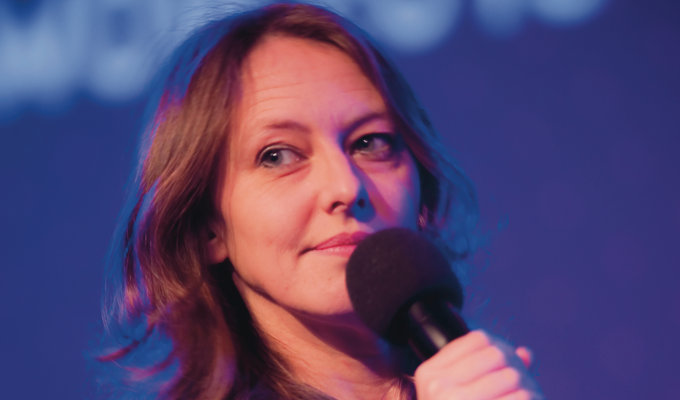
Comedian Rosie Wilby is writing a novel about misogyny in comedy – based on her own painful experiences on the circuit.
Conversations We Should’ve Had revolves around an aspiring queer stand-up who limits her career by performing only at smaller clubs where she feels safe.
Wilby says the storyline is semi-autobiographical . She was sexually assaulted after a gig early in her career – which she largely attributes to an unsafe atmosphere created by male comedians’ ‘inflammatory’ sexist jokes – and then largely limited herself to grassroots venues.
The news comes as female comedians have again been sharing their stories of abuse in the job in online forums, after stand-up Vittorio Angelone was called out for making a joke about a rape victim at a Have A Word roast and the High Court has been hearing allegations about Russell Brand from the height of his fame, with the ex-comedian denying all charges.
Last year, Julia Raeside wrote the well-received novel Don't Make Me Laugh, which also focussed on toxic male behaviour on the UK stand-up circuit.
Wilby is also using the book and tour to urge women and non-binary comedians to take more action in calling out misogyny in comedy.
Here she explains the origins of her book…
One night, early on in my comedy career, I was sexually assaulted after a gig - by a male audience member who believed he could turn me straight.
What I hadn’t really thought about until now was how much this kind of objectification, sexism and homophobia was being encouraged and incited by the inappropriate content that some of my male colleagues were delivering - outdoing one another with increasingly demeaning jokes about women - both onstage and backstage in green rooms or in cars I was sharing with a load of men. It was just ‘banter’ which you didn’t feel you had permission to complain about.
I was regularly sexually harassed like this after gigs. Although my colleagues (one particular promoter aside) were not the perpetrators, it was the generalised acceptance of wildly sexist and inflammatory material that almost always lit the touch paper for the sole female act on the bill to be mistreated by male audience members in this way.
Eventually I started to limit the venues and festivals I applied for. Understandably I wanted to avoid further violence and harassment at all costs. And I ‘ghettoised’ my career by restricting myself to queer and inclusive festivals, where I was able to build a more grassroots following and career. However, many local councils no longer provide funding for LGBT history month or Pride month events. And it is much more difficult to sustain a career in the spaces where I feel safe.
For that reason, I started writing a novel and companion live show, in which my protagonist Lou has similarly exiled herself in what she calls Queer World. She particularly loves performing at the ‘Fancy Pants’ comedy club - a fictional homage to South London’s gloriously inclusive venue The Poodle Club.
Yet when she meets Nat, a more ambitious, extrovert, heteronormative woman, she feels emboldened to step outside of her comfort zone and perform at bigger, mainstream clubs. While it doesn’t go that well for her in the short term, it ultimately provides some answers for her about where the responsibilities might lie for the assault she experienced years earlier.’
Yet Lou finds herself at her lowest ebb when Nat ends their friendship and seems unwilling to give her the support she is so desperately searching for. The women get too caught up in their own political discourse to be mindful about how the misogyny in the industry is impacting both of them. In a happy ending – hopefully that’s not too much of a spoiler – they do eventually heal their friendship and set about having their Thelma and Louise fantasy feminist ending.
I wanted to shine a light on how women are often pitted against one another in sexist, competitive environments like comedy. And how that can feel almost as painful, isolating and lonely as the initial sexism itself.
I have posted on female comedy forums asking what formalised support systems we can put in place for making complaints about, and finding support for, experiences like the one I had. And generally the advice is to go to the police. This misses the point that many marginalised communities have a very scary history with the police, where they feel that they might be treated as criminals rather than victims.
What has been heartening among the very sad stories that we are sharing and hearing, is that women in the industry are now mobilising and supporting one another in the way I had always dreamed we would. I don’t know why we felt so silenced. But we all did.
For that reason, my book and show are called Conversations We Should’ve Had. The start to calling sexism out is in talking and listening to one another.
• No publisher or release date for the novel has been announced, but she’ll be reading extracts at the Write Up showcase at St Andrew's Church in West Kensington, London, on November 7 (Tickets). Conversations We Should’ve Had will then tour in 2027. Rosie Wilby tour dates