
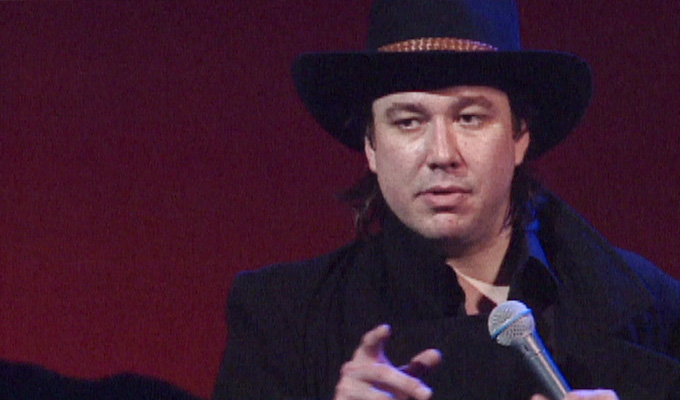
Bill Hicks

Bill Hicks

Date of birth: 16-12-1961
Date of death: 26-02-1994
Widely regarded as the template for modern stand-up, Bill Hicks combined a uniquely passionate delivery and a gift for sharp, incisive and above all funny writing to reinvigorate the sometimes moribund art of live stand-up. His uncompromising attitude and the tragedy of his early death have combined to give him an iconic status, a black-clad preacher for a disillusioned generation. If Lenny Bruce was the comic borne of the jazz generation, Hicks can lay claim to being he first rock and roll comic. But behind the image, Hicks was, above all, a hugely talented comedian. He started performing in clubs in Austin, Texas, while still at school – and at 14, far too young to even enter the bars he was playing. He performed a double act with Dwight Slade, ripping off jokes from Woody Allen albums and the like, despite being grounded when his parents found out. Once he graduated, at the age of 18, he moved immediately to Los Angeles to follow his dream. There Comedy Store owner Mitzi Shore took a liking to him and he started playing the circuit there. He wasn’t yet distinctive in his material, but he was an accomplished performer. His plans to make it never came to fruition first time around, so he returned to Austin where he fell in with a hard-living bunch of stand-ups who styled themselves the Outlaw Comics, including Sam Kinison and Kevin Booth. He found drugs, he found drink and started to become more experimental in his act – sometimes with disastrous consequences, sometimes amazing ones. He took his inspirations from any faddish spirituality that came along, and was an advocate of taking magic mushrooms to expand the consciousness. But, as a hardcore Elvis fan, he had the showmanship sensibilities of a rock star, a petulant reaction to authority – not least the first Bush government – and a passionate hatred of hypocrisy and mediocrity. It was this that informed his comedy. From here, he became a road comic, gruellingly touring the country, notching up small victories – such as appearances on the Dave Letterman show, or recording a couple of albums – along the way. Eventually he even cleared his drink and drug addictions. His biggest breaks came at Montreal’s Just For Laughs festival. In 1990, he picked up a special from HBO and the following year, when he was given a solo show, Britain’s Tiger Aspect production house spotted him, and was so impressed they recorded the entire show. Channel 4 was equally convinced, and allowed it to air as an hour-long special, and when Hicks played the Edinburgh fringe that year, he was the toast of the Festival. In 1993, he was beginning to be noticed in his homeland, too, with Rolling Stone magazine naming him Hot Comic Of The Year. But in the same year this success came, he was diagnosed with pancreatic cancer. Determined not to let it beat him, Hicks worked harder than ever. But the thing he was to become most famous for was something he didn’t do. He didn’t appear on Letterman. He taped a routine for the show taking pops at pro-lifers – and a couple of more innocuous references to homosexuality and the Bible. Yet it was dropped from that night’s broadcast. The show blamed the CBS network – though it later emerged that it was Letterman and his team that had taken the decision, muck to Hicks’ well-publicised disgust. He later performed the routine uncut on rival Jay Leno’s more conservative Tonight Show – even though Hicks considered Leno a sell-out – further fuelling the controversy. Nonetheless, he continued to tour until the ravages of his cancer made him too weak to continue. In the end, he returned to his parents’ house in Little Rock, Arkansas where he died on February 26, 1994. He was 32 years old.
Read More

When Bill Hicks gatecrashed respectable theatreland

Ray Nielsen on why the recording of his Revelations special at the Dominion Theatre was so groundbreaking

The Dominion Theatre, sitting with imperial confidence at the top of Tottenham Court Road in Central London, has always felt faintly offended by comedy. 

Built in 1929 for spectacle – for musicals, cinema, and the sort of velvet-heavy grandeur that assumes applause will arrive on cue – it is not a venue that naturally invites hecklers or awkward pauses¹.

Comedy, traditionally, prefers a lower ceiling. It likes intimacy, the sense that the comic might have to help stack chairs after the show. The Dominion, by contrast, could host a small rebellion without disturbing its art-deco composure. And yet, in the early 1990s, that was exactly what happened when stand-up — angry, philosophical, unruly stand-up — marched onto its stage.

The most famous of these incursions came courtesy of Bill Hicks, who recorded what would become Revelations at the Dominion in November 1992. This was not comedy as light entertainment. This was comedy as confrontation.

Hicks was never a natural fit for arenas, and that’s precisely why the Dominion recording still vibrates with tension. He stood alone on a stage built for chorus lines and spectacle, delivering routines that interrogated consumerism, politics, religion, censorship, and the quiet terror of watching television.

Broadcast the following year on Channel 4, Revelations captured Hicks at full strength: controlled fury, razor logic, and jokes that landed like arguments. The laughter was real, but so was the unease. A crowd of over two thousand — far larger than the rooms he usually preferred — sat rapt as he dismantled the idea that comedy should merely reassure.

There’s something uniquely British about the way that audience receives him. London crowds have always liked their American prophets slightly cross, slightly disappointed. Hicks, sensing this, leans into it. He lectures, berates, charms, then dares them to follow him further. That the Dominion — a venue more accustomed to polite standing ovations — absorbed this without flinching remains one of the great minor miracles of British comedy history.

It represents the moment when stand-up proved it could scale up without diluting itself — that ideas, not just punchlines, could fill a theatre of that size.

Occasionally, comedy has returned there in the form of one-off events, benefit shows, or crossover performances involving big names from the circuit. These nights always feel faintly transgressive, as though laughter has slipped in wearing borrowed evening wear.

What Hicks demonstrated, more clearly than anyone before or since, is that comedy could command the same physical and cultural space as serious theatre — without pretending to be respectable. He didn’t adapt to the room. He made the room adapt to him.

The Dominion Theatre remains an unlikely landmark in comedy history precisely because it didn’t change to accommodate stand-up. Instead, stand-up changed expectations of what could happen there. When people still talk about Revelations, they’re not just remembering a great set; they’re remembering a moment when comedy claimed a bigger voice.

That’s the legacy. Not that comedy conquered the West End — but that, for one furious, hilarious night, it stood in the centre of it and told the truth at volume.

• The title image is from the 2010 documentary American: The Bill Hicks Story, available from Amazon.

Read More

Published: 29 Dec 2025

King Eric | Morecambe tops list of all-time greats

King Eric

Eric Morecambe has been crowned king of comedy in…
21/12/2003

I'm no gag thief

Denis Leary has hit back at renewed claims that he…
6/10/2003

Fitting for Bill

Rare footage of Bill Hicks has been unearthed for…
28/05/2003

Win Hicks discs

A new Bill Hicks DVD has been released this week.…
26/11/2002

Bill Discs

The first Bill Hicks material to be released on DVD…
14/09/2002

Skip to page

Agent

We do not currently hold contact details for Bill Hicks's agent. If you are a comic or agent wanting your details to appear here, for a one-off fee of £59, email steve@chortle.co.uk.

We see you are using AdBlocker software. Chortle relies on advertisers to fund this website so it’s free for you, so we would ask that you disable it for this site. Our ads are non-intrusive and relevant. Help keep Chortle viable.