
Can AI have a role in writing comedy?
By comedian and lecturer Tom Short
There’s a strange new presence in the comedy writing process. It doesn’t gig. It doesn’t bomb. It doesn’t panic five minutes before going on stage. But increasingly, it’s helping comedians write their material.
AI tools like ChatGPT are quietly becoming part of the creative workflow. Need a punchline? Ask the machine. Need a structure? It’ll give you one. Need ten variations on the same joke? Done in seconds.
On the surface, it looks like a useful tool. And in many ways, it is. But it raises a bigger question: what happens to comedy when we start outsourcing the very thing that makes it personal?
Stand-up has always been built on voice. Not just what you say, but how you see the world. That perspective is usually hard-won – developed over years of bombing, rewriting, and figuring out what actually feels true to you on stage. It’s not efficient. It’s not optimised. And that’s the point.
AI, on the other hand, is built on efficiency. It predicts what should come next based on patterns. It can mimic styles, suggest structures, and generate jokes that are technically ‘correct’. But comedy isn’t just about correctness — it’s about risk, tension, and surprise. It’s about saying something that feels slightly dangerous or revealing.
The danger is that AI doesn’t push you towards that. It pushes you towards the average.
As someone who teaches comedy writing and performing, I’ve found myself actively discouraging students from relying on AI in their early development. Not because it’s inherently bad, but because I believe it risks eroding the very creative muscles they’re trying to build. Writing comedy is a skill – one that strengthens through struggle, repetition, and failure.
I’ve had students in workshops ask outright: ‘Can I just get ChatGPT to write it for me?’ And I’ve had to say no — for exactly these reasons.
In one instance, I watched a performance and could tell almost immediately that something felt off. The structure was technically sound, the rhythm was there, but it felt strangely hollow, like it had been assembled rather than lived. I asked the performer afterwards if they’d used AI to write it, and they said yes.
What gave it away wasn’t just familiarity with the patterns these tools produce, but the absence of something human. The rough edges. The specificity. The sense that the joke had come from an actual point of view rather than a collection of likely next words.
We’ve seen this before in other areas of life. Satnavs have made navigation easier, but many of us have lost the ability to properly read a map or orient ourselves without one. Autocorrect has improved speed, but arguably weakened spelling and grammar instincts. Streaming algorithms have made content discovery effortless, but narrowed our sense of curiosity and exploration.
AI sits in that same space. A powerful tool, but one that, if relied on too heavily, risks doing the thinking for us.
There’s also a wider conversation happening around how divisive this technology is. For some, it represents the death of originality, a shortcut that undermines the craft. For others, it’s an exciting evolution, opening up new creative possibilities.
And it’s important to acknowledge that AI can be genuinely helpful, particularly for people with access needs. It can support those who struggle with structuring ideas, processing language, or getting thoughts onto the page. In that sense, it has the potential to make comedy more accessible, not less.
But alongside that comes ethical questions that are harder to ignore. Questions around environmental impact – the energy cost of running large-scale AI systems. Questions around ownership – whose work is being used to train these models, and whether those creators are being credited or compensated. And questions around authorship – if a joke is generated by a machine trained on thousands of comedians, who does it really belong to?
There’s also a deeper issue around audience connection. When someone watches stand-up, they’re not just listening to jokes, they’re responding to a person. The imperfections, the hesitation, the sense that this idea has come from somewhere real. If that process becomes partially outsourced, does the connection weaken? Or does it simply evolve?
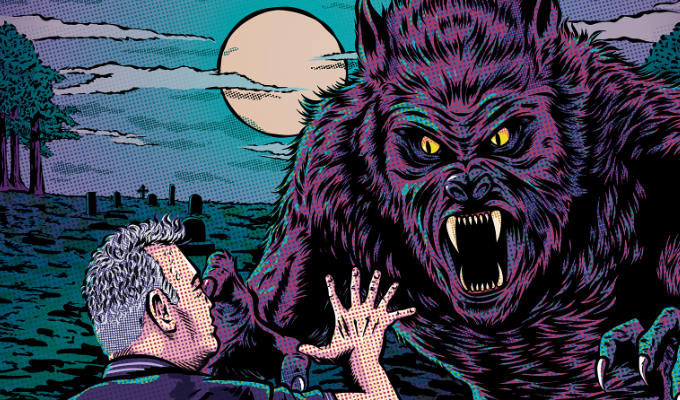
To explore this, I’ve been developing a show where I actively use AI as part of the performance, generating ideas live, shaped by audience suggestions, and building material in real time. It’s unpredictable, often chaotic, and occasionally terrible. But that’s where it becomes interesting.
Because what the experiment reveals is that AI isn’t a replacement for creativity, it’s a mirror for it.
It can generate ideas, but it can’t decide which ones matter. It can suggest jokes, but it can’t feel when a room shifts. It can produce structure, but it can’t experience failure – and failure is where most good comedy actually comes from.
If anything, AI exposes what comedians really do. Not just writing jokes, but filtering, shaping, and taking ownership of them. The human part of comedy isn’t just the output – it’s the judgement.
So the question isn’t whether comedians will use AI. They already are. The real question is how much of the creative process we’re willing to hand over before something essential starts to disappear.
Because comedy has always been inefficient, messy, and personal. And if we smooth all of that out in pursuit of better, faster material, we might end up with something that works… but doesn’t feel like it belongs to anyone.
And that might be the least funny outcome of all.
• Tom Short will perform I Get ChatGPT to Write My Edinburgh Show at Hoots @ Nicholson Square at 10.15pm during the Edinburgh Fringe.
Published: 26 Mar 2026