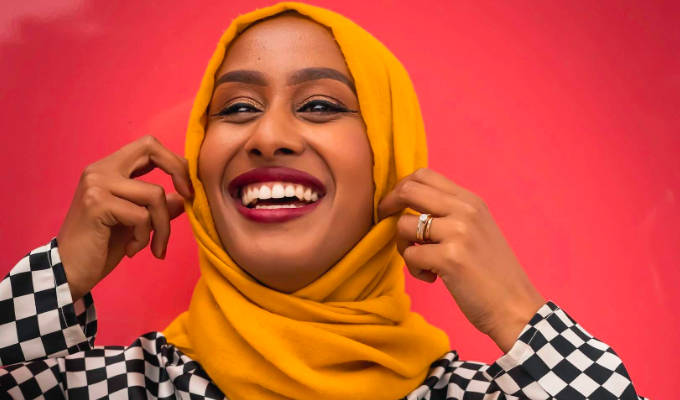
Ola Labib

Ola Labib

Ola Labib is billed as the only black, Muslim, female Sudanese comedian performing in the UK
Read More

'In my own home I'm diabolically satanic, but I could never be like that on stage'

The Big Interview: Ola Labib

The first Sudanese woman to perform stand-up at the O2 Arena in London, Ola Labib has just published How Not To Lead A Double Life, an account of dating and performing comedy in secret without her devout Muslim family's knowledge, while struggling with the workload, racism and sexual harassment of being an NHS pharmacist, and ultimately, risking her freedom to be with the Sudanese-American rapper Kashta.  

Here, she talks to Jay Richardson about new developments with her semi-autobiographical Channel 4 comedy Blap, The Pharmacy, coping with childhood and recent trauma, how her religious faith is reflected in her writing, being seen as ‘black enough’, and modelling for Vogue.


How aware were you writing this book that the stakes were higher than in most comics' memoirs?

Yeah, I've had a full-on life. Some of the dialogue was dramatised to make it more interesting. But the series of events are what I lived through.

How did you find writing it? 

The story was optioned four and a half years ago by a production company, Balloon Entertainment, after producer Danielle Scott-Haughton heard it. I'd pitched her a completely different idea. But we were talking and she said, with all due respect, what you've brought us, let's put that aside. Your story is the project we should develop.

So I wrote a script. Lots of things happened in between and it never managed to get past that final hurdle. After five years, I said to my manager, why don't I do it as a book?  I read lots of books and reckoned it would make a good rom-com rather than a memoir. We already had so much material from it being a scripted project so I just converted it. 

Danielle ended up leaving Balloon [to become a BBC drama commissioner]. She was my mentor. Unfortunately, she passed away just as I got the news that it had been commissioned as a book. I've dedicated it to her.

Are you still hoping to adapt it for the screen?

That's the plan. I was quite new when this project was pitched to production companies, they didn't really know who I was. But Danielle said she'd always cared about people's voices and stories, regardless of how long they've been going. I'm really hoping that now the book is out people enjoy it enough so I can develop it back into a scripted format.

Can you clarify how much artistic licence you've taken?

The dialogue has been compacted. And I've added a bit of humour so it's more readable. Whenever I'm telling a story, I tell it how I remember it in my head. Adding humour, dramatising it a little, just bringing more energy. But the actual events are what happened.

The Pharmacy is similar. As a pharmacist for 14 years, I would come into situations where you have to be really professional. But The Pharmacy features my alter-ego, Lola, who does things how she wants to. I would never be able to act like that in reality. That's why the book is called How Not To Lead A Double Life. I'm airing that little voice inside your head that can't always speak out loud.

You write about being groomed by a 24-year-old man when you were 14. How was it revisiting that?

Really difficult. I've wanted to talk about it previously. But I didn't want to talk about it on stage because in comedy you have to find the funny in every situation. You can find the funny in a lot of things, whether through sarcasm or being a bit wry. But that's something I never thought I could make funny. 

Even though I've never spoken about it, it's a really important topic to bring up because people from everywhere go through the same thing. Insecure or vulnerable people are the ones targeted. Parents can read this and have a greater awareness of how these things happen. I didn't know who to blame at the time. 

In a book, surrounded by other incidents is a good way to talk about it. By not making it the main thing.

Have your family read the book?

They know I've got a book out but they don't know what it's about. I've told them it's based on my life but that a lot of it is dramatised and exaggerated to make it readable. Honestly, I've only read two memoirs in my life, Nelson Mandela's and Malcolm X's. I'm not Nelson Mandela or Malcolm X. I just wanted to make it interesting and add my humour to it.

That's why I put a disclaimer at the beginning. Like, listen guys, this is from memory and as we know, especially as women, we tend to exaggerate, dramatise and remember things how we want to remember them. So if anything is used against me later, I'm like: 'Mate, I've already said. Take it how you want to take it.'

What about your parents' reaction?

I don't think it's going to be an easy read for them. They know about [the grooming] and it's something we've processed together as a family. I'm very blessed that nothing more happened. I was put in that situation, very quickly realised it wasn't right. This is for the people in that situation who don't have that opportunity. To tackle it early rather than let it play out for the worst.

Look, there are certain things you have to sacrifice for the greater good. 

Oh God, I sound like Superman. There might be a lot of people from backgrounds like mine who've been through something similar but haven't spoken about it. I'm biting the bullet so others can come forward and be open. So it's an issue that can be tackled.

Does your mother accept your career and husband now?

Oh totally. Things have happened that have made her think, ‘You know what? It could be a lot worse.’ She absolutely adores my husband.

Some of the knottier chapters in the book, do you anticipate talking about them on stage?

What I went through when I was younger, I can't see any funny in that at all. It was such a struggle to write it on paper, let alone talk about it out loud and try to make humour out of it.

But my best friend marrying my ex? I mentioned that in my first show, Polarising. They weren't married for that long. She's remarried, he's remarried. But then he married someone who was a fan of mine. She came to see my show and didn't know there was any relationship between us ...

Oh wow ...

A friend told me that she couldn't believe I'd told that story. And I was like, 'well, of course. It's hilarious now'. Then she explained that he was in the audience with his new wife ...

With all that had happened I hadn't spoken to him in three years. But he went to see Mo Gilligan at the O2 Arena and I was opening for Mo at the time.

Then he messaged me. And he didn't know I was married to my husband even though he listens to his music. I need to talk about that on stage because it's crazy. 

The more intimate stuff I can talk about seriously. But not through humour. Maybe one day. But not right now, that's not something I see happening.

How was that O2 show? Did it make you think you could sell it out yourself one day?

It made me think I could open for someone else there! Let's take it one step at a time shall we?

I found it interesting that you have to be nice to hecklers during Ramadan. Are your comedic instincts often in conflict with your faith?

Certain opportunities I get presented with definitely conflict my faith. I do a podcast, Halal-ish [with Shazia Mirza and Zain Comedy], that's relaunching in August. This is literally a topic we were talking about yesterday, how as Muslims in the industry we get tempted by opportunities that go against our faith. 

There have been times when something's gone against what I believe. Not even religiously but ethically, and I just couldn't do it. 

This is ridiculous but I was asked to do a gig sponsored by Ciroc Vodka. I don't drink, religiously. And alcohol is not something I'd ever indulge in. But they offered me an extra grand and a half to have their picture behind me. So when I'm promoting the night, I'm promoting the drink as well.

Back then, I was reducing my hours as a pharmacist to balance it with comedy. That was a lot of money. But it felt like an easy no. 

How does your faith impact your writing? I've talked to religious comics who've likened it to having two referees in their head critiquing their material...

Oh, totally, that's it described to a tee. Because I've got quite quick responses, sometimes I say what's in my head and then suffer the consequences later. Especially if you've got a heckler in. Or you're in an interview and start over-expressing yourself. Sometimes you're like, ‘oh man, should I have said that?’

I have a dark humour outside of comedy. In my own home I'm diabolically satanic. But I could never be like that on stage.

Do you feel as if you're self-censoring? 

Whether I like it or not, being part of a community, whether it's the Muslim community, the Sudanese community or African community, I have a responsibility to represent. And represent positively, because there aren't many role models that look like me. From my background. 

I'm the only Sudanese woman in mainstream stand-up. A lot of people don't know any Sudanese women. So they're going to look at me and be like, 'So this is what Sudanese women are like'. I'm under pressure to represent positively. 

Sometimes I'm tempted to call someone a massive bellend on stage. But if that gets out, people are going to be like, 'Oh, do Sudanese women call people bellends? That must be normal in their community.' So I tread a lot more carefully. And I think that's made me a better writer because I really need to think hard about what's within my boundaries.

Do you resent that responsibility? Do you feel as if you have to address your hijab?

This is something I'm very passionate about. When I first started I felt like I had to, like it was the elephant in the room. You don't see many hijabi comedians. But now there's maybe four or five. So it's come a long way!

But hijab is not part of my comedic identity. My first show was about anger management. My second was about transitioning from working in a pharmacy to comedy. It's not something I talk about on stage now. I'm a comic that happens to be a hijab-wearing Muslim, not a hijab-wearing Muslim that happens to be a comedian.

Even on certain projects I've worked on, they've been like, 'Oh, why don't you talk about the hijab?' And I'm like, 'Sis, this isn't everything about me. If I wore a baseball cap 24/7 would you be like, "Oh, talk about your baseball cap?"'

In this very Islamophobic age, I want people to know there is much more to us than our faith. It's a way of life but everybody has different characteristics, different senses of humour. There's more to me and I'd like to think I don't make that the centre of my comedy anymore. 

In the last three and a half years, I think I've made one comment about it. I did Secret Comedy Club in Brighton where there was a very pervy man in the audience making weird comments. And I said people like you are the reason I'm so glad I wear a hijab. That's the only time I remember mentioning it in however long.

You write about not being considered ‘black enough’ by some ...

Sudanese people are such a small minority in the UK. When I started, comedy promoters had a certain idea of what they perceived as African. We come in all shades, colours, ethnicities and backgrounds. And it was a long time until I finally started to dip my toes into the African/black circuit. My management pushed me towards that.

I used to get asked to do Asian gigs a lot, Arab gigs too, and I turned them down because I'm not Arab or Asian. Because I'm Muslim, with my skin complexion, I'm automatically lumped into boxes I'm not part of. I've written quite a lot of comedy about that. Educating people about where I'm from has helped me sharpen my writing. 

And it's opened doors for me when someone's genuinely curious about my ethnic background. As I say, I've turned down a lot of stuff that doesn't represent me. And there needs to be more education, it's something that's not been tackled by the industry. But as my career develops that's something I can dip into. I pitched a documentary about it a while ago but it didn't happen. You can't have everything.

You mentioned rising Islamophobia. Is it worsening on the comedy circuit?

Not necessarily in comedy clubs because they know the consequences. You can always hit back if it's a heckler. If someone was genuinely there to Islamophobically attack me, obviously there are bigger consequences. Outside of comedy though, whether in public or on social media, I would say that this is the worst it's ever been. And I was a hijab-wearing woman post-9/11. It's worse now than it was then. One hundred per cent.

You've spoken about finding it hard to gig when violence broke out in Sudan. How do you focus on stage when you're preoccupied with such horror?

I stopped gigging for a little bit, especially when my village was invaded. I just couldn't because I knew my family were fleeing. But I had to get back into comedy for fundraisers, that was the only way we could make significant amounts of money to send back. Through those fundraisers and donations we managed to provide 50 family-sized tents to families living on the outskirts of the Al Qadarif  region.

So there were advantages in me returning to comedy. But the reality is, and horrible as it sounds, life must go on. That's the beauty of comedy as well. On stage your adrenaline is pumping so much in that moment, all you're thinking about is, 'I really don't want to bomb, I don't want to bomb… What's the audience like?' There's so much on your mind that it helps. The bad stuff's never out of your head. But it does suppress some feelings. Because, at that precise moment, all you want is to do well.

It's just like any other career. If I was still a pharmacist I would take a few days off. My husband had to. His parents were in the middle of the attacks when it happened but he had to go back to work. If we don't work, we don't eat. And if we don't work and eat, then we can't feed our families back home. 

There are times… I remember I gigged in White City and it was a really good night, I was on such a high. Then I bumped into Kane Brown and he was like, 'Oh, I'm really sorry about what happened to your family'. 

And I went from peak adrenaline, 'Oh my God, I smashed that gig!', to, in a split-second, brought back to the reality of what had happened two days before. My cousin's daughter was shot and unfortunately passed away. I just completely broke down. 

So it's not easy. But it's the dilemma for anyone whose family is going through wars or famine, the reality of a lot of diaspora who live in this country. It's been my parents' reality since they came to this country. You have to learn to live with it and do the best that you can.

Have there been any further developments with The Pharmacy?

Yes, I'm working on it at the moment. They've commissioned a 30-minute pilot. By tomorrow I should have the final version to submit and then it's just a waiting game. The feedback I got from the Blap was absolutely phenomenal, I was overwhelmed. I'm really hoping they pick it up.

Will you be hoping to keep the same cast? 

Oh, yeah. I love the cast. Nabil [Abdulrashid], Sue Vincent, Finlay [Christie]. I would definitely like them back.

And your husband played your love interest? 

As the creator I was allowed to make suggestions to the production company. Only then did the casting director get involved, going through people who were potentials. He's been an actor since 2011 and has done a lot of work, so he auditioned like everybody else. The casting director didn't know he was my husband. 

She didn't think it was worth even auditioning anybody else, we had such natural chemistry. And I was like, 'I bloody hope we have natural chemistry. He's actually my husband'. 

He would have got it anyway because it was perfect. She saw that. It caused a lot of extra spark because people were like, 'Wasn't she in this guy's music video?' If you Google, one of the most searched things about me is 'Who is Ola Labib's husband?'

Stand-up is such an individual job. How do you find television collaboration?

I guess it depends. But I was so glad I worked with Objective. I didn't feel like I had to compromise much at all. They were really good, really understanding and liked the humour I brought to them. There was nothing presented to me that I was like, 'Oh my God, I can't do that'. It was such a positive experience from beginning to end.

Is it the best revenge, turning your experiences of racism and harassment into art?

Oh, it's a bloody fantastic feeling. Two weeks ago I went for a walk with one of my cousins, not far from where I live. I'd just done an article and photoshoot for Vogue and I was on top of the world. Then someone told us to 'Fuck off back to Pakistan'.

Now, usually, I would be ready to respond. But I just kind of smiled. My cousin asked if I was OK. I was like, ‘Yeah mate, I'm fine. I'm in Vogue. I just don't care. I've just written an article and had something posted that's had more than 150,000 likes, comments and messages.’

Obviously, I do care though. I live in a place that's not that multicultural. But what he said doesn't take away from my blessings. 

Had that been seven years ago I would have probably cried for three or four days. But I just did Bradford Literature Festival. I told them: 'I was walking down the street, someone told me to "Fuck off back to Pakistan" … And you know, his dream came true. Because I'm in Bradford!'

I can joke. Doing what I'm doing has changed my perspective completely with how I process negative experiences.

Read More

Published: 9 Jul 2026

Agent

We do not currently hold contact details for Ola Labib's agent. If you are a comic or agent wanting your details to appear here, for a one-off fee of £59, email steve@chortle.co.uk.

We see you are using AdBlocker software. Chortle relies on advertisers to fund this website so it’s free for you, so we would ask that you disable it for this site. Our ads are non-intrusive and relevant. Help keep Chortle viable.