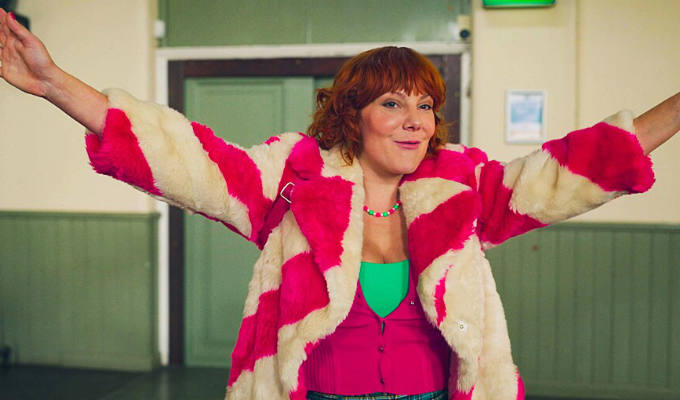
 © BBC/Expectation TV
 'Winning a Bafta is like getting a penis'
Sophie Willan on success and struggles
Sophie Willan has revealed she has named her Baftas after women who inspired her, as she spoke candidly about her upbringing.
The creator of Alma’s Not Normal told journalist Elizabeth Day on her How To Fail podcast that her first award was named Caroline – ‘because I won the Caroline Aherne bursary’ – and the second was called Julie, after Julie Walters.
‘People don't fuck with you when you’ve won Baftas,’ Willan added. ‘ I think as a woman getting a Bafta is like being given a penis, it really is. You're not going to be treated with all the respect, but you'll get treated like a man who works at Tesco would. Then you get another one and you get treated like a man who works in H&M….’
She also spoke about having a difficult time in primary school ‘because it was like trying to contain a wild animal.
Willan explained: ‘ I didn't understand the rules… it was like trying to explain to Mowgli that you can't punch someone in the face when you're a bit upset.
‘It was baffling to me, so I would find myself in trouble a lot and just accidental. Then in secondary school, I just wasn't ever very good at routine. Sitting down. I was excluded – like Alma – for arriving drunk in a bikini, and then that continued.
‘College was upsetting because I actually got into college even though I didn't have the qualifications. I was doing really well because I did drama, so I kept getting distinction. I was really chuffed with that.
‘But what happened was, I think I started to slowly process all the stuff that had been going on and I was independent living my last year of secondary school and the two years of college and that was quite a lot. Living alone and going to college is a really weird experience.
'All your friends, you'd go out partying with them on the weekend and then they'd all be like, "right, got to go home. I'm going for Sunday tea now and got to have a bath and my mum's got me whatever" and I was just in my weird little flat usually with no electricity because I'd spent it all on ecstasy tablets. I was lying in candlelight on a comedown having been at Wigan Pier. There was no structure.’
She also said that despite their problems laughter ran in her family as they were all ‘emotionally deranged people that have a good sense of humour’, adding: ‘You can’t not find things funny.
‘I've got an Uncle Malcolm who's got schizophrenia and the last time I saw him as a child , he chased me down the road with a cricket bat… we don't know why. He was just in a bad mood
‘Then I saw him again at my Great Granny's funeral and it was like nothing had happened. And he's outside, he's got two security guards with him – massive lads – and he's quite small.
‘He was singing with the two security lads outside the funeral, We'll Meet Again, Vera Lynn, but then he just panned over to one of the security and suddenly the security guard had the most operatic voice. Things like that are funny.
‘My Great Granny, she died and she was a bit of a cow but I think subconsciously everyone had forgot to put on a wake for her because they just hated her. So we got to this pub opposite and we're like, "oh shit, better get some food". There was no food so like, "shit, get loads of packets of crisps". So we just got loads of packets of crisps and opened them out on table with that. Help yourselves. Stuff like that.
Day also asked Willan about the links between comedy and psychosis, to which the comic replied: I think I'm a living embodiment of that fine line. They say that people with psychosis – well comedians – connect thoughts that are not normally connected. We're naturally rebellious, angry people who struggle to follow the rules... Like do you know the Joker? I keep going back to him. I don't know why.
‘He's dancing on those steps and I thought, "I've done that so many times drunk|". You know, you're coming home from the pub and you've got your podcast on and you're like, "yes".
‘There's a lot of madness, rebellion, psychosis, connecting thoughts that don't normally connect. Fast-paced, you can't really sit still… I'm always up on my feet. You've got going a million voices at once.
‘I'm very lucky because there's loads of psychosis in the family so it's quite nice if you can harness the psychosis.’
Willan also said she always had a feeling of being an outsider which helped her become a comedian – because ‘it's a strenght, isn't it? I've lived in loads of different worlds and… you never quite fit in perfectly anywhere but then also you can get on with everybody and fit in everywhere.’
She added that: ‘The industry's weird because it is still predominantly very middle class’ but also that ‘I also get a bit irritated with the rhetoric about class.
‘I think it's still a big thing and we need to talk about it, but don't let it detract away from you actually doing the work to be the best you can be.
‘I do think there's still a massive problem with the London-centric nature. Everything's in London and they pop a few things up here. That's a bigger problem I think for me. Well actually no, they're both problems actually… I think we just want to try and develop the conversation a bit, rather than getting too stuck in identity politics and actually look at it economically as well, and what are we going to actually do. How do you change it rather than going like, "oh, I don't know what quinoa is, so I must be working class". That's very dull.’
The podcast is all about failure, and Willan said her debut Edinburgh Fringe in 2014 was one of her biggest failures.
The show was framed as a detective story about how she and her ‘slightly-psychic Gran’, found her long lost father.
Willians aid she and her producer, who she was dating, were too intense about the project, and put too much expectation on ‘this is it, this is my moment’.
She explained: ‘Each Edinburgh I learned so much, but I think mainly what I learned is it is bullshit. You're shoved up there, you spend thousands and thousands of pounds then you get told that you've got to be nominated for the Edinburgh Comedy Award, and that's not something that you go up there thinking about.
‘You get told constantly, "you need to be rooting for that". It was like being like in the Marines but for comedy.
‘I look back and I think it wasn't worth that stress actually. It should have been a really joyful experience going up to Edinburgh every year, doing a show, working on the show, connecting with friends. That bit was all lovely. But then this other side of it, these hungry agents and hungry reviewers and the capitalism…’
Willan’s episode of How to Fail with Elizabeth Day is available on all podcast platforms today.
Published: 24 Dec 2025