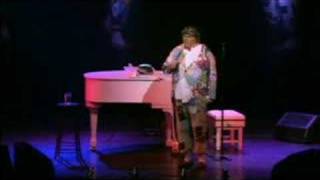
From the rafters of Lancaster’s Grand Theatre, Roy Chubby Brown is a difficult man to measure.
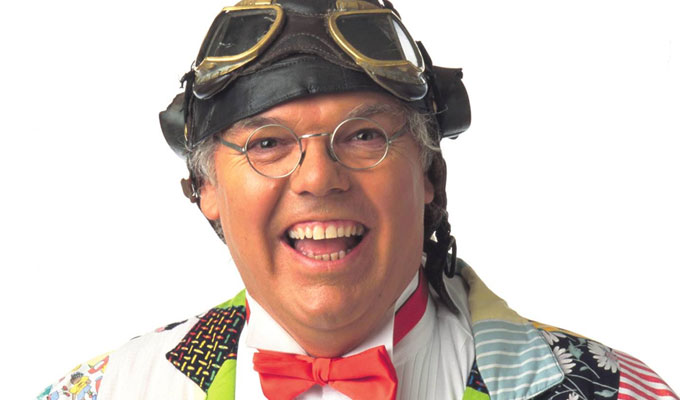
I’m expecting someone big. To Brown’s admirers he is a comic giant, whose titanic reputation is built from both the longevity of his 50-odd-year run and the extremity of his act. Media coverage on either side of Brown similarly bigs him up, so that he may be ‘the most significant English male comedian of the past quarter-century’ as well as ‘Britain’s most offensive comedian’. Strange quirks in his profile (birth name: Royston Vasey; with early stints in borstal) and an eccentric stage get-up (including a flying cap, moccasin slippers and a multi-coloured patchwork coat) further strengthen Brown’s status as a larger-than-life kind of character.
As blue comedy’s prizefighter made his way from stage left into a flood of yellow light, an amassing chorus chanted ‘You fat bastard’ to greet a grandee who had his audience where he wanted them. His was the call, and their response was automatic.
The room had all the fanfare and direction of a gospel liturgy, and the pugnacity and anticipatory violence of a darts match. But then there is Chubby, in the flesh, who for all his physical substance and reputational largesse appears now as a strange sort of miniature from the vantage of my high-up, far-back seat. His Teesside snarl has a new, weaker texture; the fresh promise of outrage falls away to something over-rehearsed and under-delivered. As I struggle to find Brown’s real scale across a perplexing evening in July, I become more and more convinced that whatever me and the crowd are watching is quite adrift from what we’d expected.
I’d first learned Brown was coming to Lancaster when my colleague Westie told me he’d bought tickets and couldn’t wait for Friday night. For Westie, Brown was ‘a true fucking legend’, because ‘they’ve been trying to get him for years and he’s still going, and he couldn’t give two fucks what they say about him either way’.
There was something to Westie’s claim. In 2022, a Brown gig in the neighbouring town of Morecambe was cancelled by Lancaster City Council following a petition calling for the ban of Brown’s ‘racist, misogynistic, and homophobic’ act. ‘Woke culture wins again’, explained Ritchie Hoyle, Brown’s tour manager. The year before, a gig had been pulled in Sheffield; this May, the Exmouth Pavilion changed its mind about hosting Brown, who was scheduled to play in August.
Here was credible evidence that specific groups really were out for Chubby, yet I suspected Westie’s ‘they’ really referred to an ill-defined but broadly recognisable group of hostile parties: the liberal media, student politicians, alternative comedians (my politics and sexuality would probably make me a Brown antagonist, too).
Brown would’ve liked Westie’s ‘us and them’ framing. Commercial fruits are surely promised to those who can capture a popular mood of elite disdain in the country. Still, I was suspicious of Westie’s suggestion that Brown was immune to criticism. After all, this was his ‘No Offence Meant’ tour, which seemed like special pleading from a comic distinguished for his mastery of bad taste. In his 81st year, I wondered, had Brown stalled at a juncture between his need to be loathed and a desire to be liked?
Friday night. A loosely grouped queue fell out from the box office in twos and threes. Men with girlfriends, or the lads. Everyone smoking Super Kings and drinking in the sun. Inside was a crush, as long lines formed between the foyer and the bars. I skipped past them and up to the gods, where the bar staff explained that for Chubby’s shows, ‘after 8, it’s a dry house’. That seemed important; behind the sell of a wild night were signs of careful management and restraint (I’d later learn RCB is a teetotaller, which tallies with a general showbusiness professionalism).
I bought a drink and moved towards the corner of the room, where I got talking to a couple whose age was a bit closer to mine – 24 – than Brown’s. I told them that I’d expected an older crowd. ‘He was my Dad’s favourite’, the woman explained: ‘One Christmas, when he was quite ill with cancer, we decided we wouldn’t do a big dinner, and a new Chubby DVD had come out, so we just ordered fish and chips and watched that instead’.
There was an interesting image; one that felt hard to argue with. Mostly I’d interfaced with Brown in short, bitter little bursts on Facebook and Instagram. I’d never seen him on the telly, nor had I really pictured him in the soft lights of a festive domestic scene.
Clips online show topical material, concentrating on free speech debates and cancel culture, or British asylum policy (where now is unfailingly presented as worse than then). But I was beginning to wonder how much of the appeal to see Chubby ‘tell it as it is’ wasn’t really a desire to hear him tell it as it was.
Considering Brown’s age, this was surely a retrospective tour. Expect the greatest hits, but also the sentimental treatment of an increasingly distant past; Brown will take you back to the music hall, and those now defunct working men’s clubs where he cut his teeth, and to a Britain which was more white and less diverse.
‘Simpler times’ where Brown’s comedy more easily enjoyed success. Leaving the couple I ran into Westie, wearing a merchandise jumper for the 1984 comedy Gremlins: ‘The greatest era, dude’. He told me I was in the right place; ‘Chubby’s a proper wind-down’. Which was strange, given I thought Chubby was a proper wind-up. It made sense though. For those who feel Britain’s recent decades mark a period of decline, there’s always the promise of improvement in looking backwards.
If Brown was selling retro, Denise Danielle - the night’s warm-up act - was somewhere closer to kitsch. 1980s hits were stomped and clapped through; Stevie Wonder, AC/DC and Blondie all got the same broad treatment, losing their distinctions to a chesty, power-ballad style. Behind the singer two golliwog dolls and a policeman’s helmet were laid out on a table, above which was a projected slideshow, exhibiting Brown’s various good works, in a children’s hospice, or holding a big cheque for a charitable cause.
The crowd seemed antsy, uninterested in the hand-waving directions of Danielle’s club-act. In front of me, sweat poured from three coked-up lads; a few rows back a rowdy gay couple encouraged me to fill an empty seat next to them. By my side was Mike, a mild-mannered man of about fifty, explaining to me how Chubby had ‘plenty of coloured mates’, who were seemingly invoked here as a kind of insurance against any charge of bigotry.
As the decorated fire curtain lowered for the interval, fantastic Regency characters reflected the evening back towards us: make-upped jesters, devilish grinning faces, the world turned upside-down for a night. After ten minutes a voice came through the intercom: ‘Ladies and gentlemen, welcome to the Roy Chubby Brown show. If you are easily offended and lack a basic sense of humour, do yourself a favour and fuck off, you daft cunts’. Up came the fire curtain, and on came the fire.
‘Sorry about my limp, I’ve got a new knee, a new hip. Never play leapfrog with a fucking poof before you come on’. Brown’s opener was a neat blueprint for his act: set-em-up, knock-em-down one-liners, where the funny came from his age (and aged reference points), or something to do with sex, or a prejudicial punchline. Or all three. Examples include: a repellent ‘bit’ about a Tinder date with a woman from Trinidad and Tobago; impotent jokes about Brown’s impotence; dated cracks about historic figures (Tony Christie, John Lennon’s assassin); and an infinite supply of jokes about hideous wives and loose women and lesbians, and their cunts, or pussies, or minge, and what Brown would or would not do to them.
The biggest laugh of the night was for a routine about an Iranian asylum seeker contemplating suicide on a bridge: when Brown barked ‘Jump, you cunt!’ he really turned his audience on, their collective belly laughter drowned out only by the rapture of their righteous applause. I felt conspicuous then, amongst all the relief and satisfaction, and suspicious of Mike, my polite companion, who found this all a lot funnier than I did.
How could Brown justify something so hateful? ‘We come from a society where a joke’s a joke…And now we live in a miserable fucking bastard society’. But I wasn’t miserable, only unconvinced. Unconvinced of Brown’s craft, and unpersuaded that its only function was to make his audience laugh; how otherwise should you explain the shared political sentiment of Brown’s violent material and those other undisguised border control fantasies of ‘shooting the boats down’.
The worst of Brown’s bad taste was, perversely, where the night felt most secure. The act was clearly well-worked and no doubt familiar to die-hards in the crowd. The transaction seemed obvious too, cash exchanged for something generally prohibited.
It doesn’t surprise me Brown’s such a success at the seaside: there’s a peep-show thrill there, the crowd hungering for him to reveal the full, naked extremity of his beliefs; he’s predictable fun, too, like a faulty arcade fortune teller that for a few coins spits out some racist line you suspect you’ve heard somewhere else before. Rants about Lenny Henry ‘trying to cancel Christmas’ or Keir Starmer’s management of the Southport riots also capture the unrestrained, snarky topicality and slick delivery of his viral Facebook clips (where Brown’s establishment send-ups presumably complement those of Nigel Farage or Rupert Lowe).
More often than not, though, the evening slipped from its highlight reel. Repeatedly Brown’s acid tongue was unable to find the right words, his dark, stuttering searches for the next bit unsettling to witness. Jokes that didn’t work were followed with accusation (‘Just me that got that one then? You pack of cunts’), which implied the problem might be with us, but, by its third panicky repetition, flagged the material itself as faulty.
Less convincing still were Brown’s forays into song. On a grand piano, the act ventured backwards into music hall traditions the audience seemed lost inside of. Brown’s voice struggled to project over his chords. What lyrics you could discern (‘If I could see Dolly Parton’s tits…’) resembled the contrived and extraneous content of a dirty limerick. It felt like a mistake in the evening’s progress to take up residence so far down memory lane. At one point, Brown recited by memory the titles of about 100 Beatles songs, a performance which fell somewhere between a dull party trick and a pensioner’s insistent demonstration of their mental acuity.
After that Brown led a tribute to British comics passed (with Joan Rivers’ inclusion explained by her husband’s being born in London – no one tell the arch-nationalist that Edgar Rosenberg was actually born in Germany); Send In The Clowns played over a black-and-white slideshow journeyed as far back as Charlie Chaplin and as recently as Caroline Aherne - whatever Brown’s admiration of Aherne, it certainly wasn’t reciprocated.
It all felt quite revealing, the inclusion not only of Brown’s dead contemporaries but also the comics of his own childhood; the grand sweep backwards the preference of someone taking stock, reflecting. It is both a testament to Brown’s self-confidence as a stage grandee and suggestive of darker concerns that he should choose to lead a funeral procession through a comedy show. And it’s not, really, what people have paid to see. I watched as the three cokey guys ahead of me made for the exit, their heartbeats clearly having fallen out of rhythm with the faltering tempo of Chubby’s show.
The End? Not quite. It seemed the night’s ringmaster showman had one last trick in store for us, as the first unmistakable chords of Hot Chocolate’s You Sexy Thing reached us from the stage. ‘I believe in miracles’, the song goes. After what I witnessed, I believe in apparitions.
Roy Chubby Brown had reappeared on stage, naked apart from a large, furry prosthetic genitalia saddled around his waist and wrapped between his legs. His smile was greedy, flaunting. In his provocative eyes I could find no suggestion of doubt that this was exactly the right thing to be doing. It was with full confidence that his fleshy mass pirouetted and bent down to dip his fuzzy testicles into a policeman’s hat. N
ot knowing where to look, tracing the long white vein of his microphone wire across his stooped, pink back, I felt I had finally mapped all dimensions of Roy Chubby Brown. No further questions, your honour.
He turned back to face us and with all his vitality declared: ‘If I’m not dead, I’ll be back next year’. Seeing is believing, and watching Brown’s undying love of the game, or simply an unfathomable terror of life beyond it, I finally recognised the man as he was, inside his own plain, naked truth.
Still, it couldn’t resolve for me all the other ways in which he was a hopeless muddle of contradictions. A vintage act who’s a viral hit; charity man whose comedy is so extremely uncharitable; an apparent ‘comic’s comic’ whose material seems unreconstructed and undeveloped. Which is fine.
What rubs is Brown’s concerted efforts to smother his extreme eccentricities in a pretence of simplicity and straightforwardness. ‘I’m not a racist, I’m just a comedian’. Which is a flimsy dichotomy, and a troubling formula: the supreme veneration of ends as slippery and varying as making an audience laugh naturally justifies any and all means of getting there. Which probably explains why an 81-year-old man, shorn of his clothes, is looking back at me, cap in hand, from between his tired, bent-double legs. But when he inevitably reminds me that ‘you’ve gotta laugh!’, I might have to reply that, yes, Mr Brown, you’ve really gotta, but not at this, and certainly not at you.
•This piece first appeared on Daniel Sumsion’s Substack