
Alex Mitchell
Leeds-based comedian with autism and Tourette's, Alex Mitchell made the final of Britain's Got Talent in 2024
Read More
Comedian Alex Mitchell on his experience of abuse, judgment and stigma
Alex Mitchell tells his experience of abuse, judgment, treatment and stigma as a professional comedian who just happens to be disabled.
We’re all aware that trolls exist, let’s be honest, they’re not the kind of people to shy away from sharing their opinions. Dealing with trolls is of course a part of the comedy industry, if anything it’s an expectation for anyone starting out. What I didn’t expect as a 22-year-old, recently disabled, one year open micer was a barrage of arrogance and ignorance from inside the industry itself.
In August 2022, four months after my first open mic spot, I became disabled. I developed functional neurological disorder, a neurological condition that affects the chemical makeup of the brain and how it functions. The best metaphor I have for it is that my operating system has malfunctioned.
There’s no known cause, treatment or cure for the condition. I woke up one morning with a stammer, a few weeks later I’d developed Tourette-like tics, I then started to see a decrease in my mobility, and now I suffer from Blackout and fainting. When the tics and stammer began, I thought I was about to lose everything. Not least the thing I loved the most and the part of my life that gave me a release from the pressures of a tough job and a stressful work life balance – stand-up. I was scared. Scared of what one of those online trolls would say if they saw a clip of me online, or even worse live on stage.
The first time I got on stage with my stammer and tics was both terrifying and awful in equal measure. The fear that some man from the back of the pub would shout something hideous was tearing me apart, add to that, the problems with my speech are affected by my emotional state, and this horrific equation had only one outcome – I managed two punchlines in ten minutes.
But no one said a word, not another performer or audience member even looked at me in any sort of way that could be construed as different from normal. Things seemed pretty sweet, I wasn’t sure ableism was even a thing anymore, I was working damn hard and some cool work was in the diary.
In 2024 I got on telly. I knew I’d get some abuse online, like I said earlier, it would be insane to think trolls and bigotry don’t exist. It’s worth saying that as well as being disabled I’m autistic and bisexual – quite the cocktail for anyone who doesn’t want to see anyone but themselves on the box.
Every so often I’d get a late-night DM calling me a slur or wishing death on me, and a couple of friends would send me their favourite abusive comments under my clips online (granted they were quite funny), but I expected this and could move on relatively easily.
After I did my second set on television I had a meeting with a senior figure in the entertainment industry, away from the cameras and the show I was recording. They told me I should feel ‘lucky’ telling me my voice was my ‘route in’. What really stuck with me though was the following sentence: ‘We see lots of okay comedians, the ones who do well use their quirks, you should be grateful for yours.’
The first senior figure I’d met in the world of entertainment had just called my life-altering disability a ‘quirk’ and I was supposed to be grateful for it. I wouldn’t say I was angry with them for saying this. I guess I was more confused by what they meant and why they felt the need to say it.
In the year of doing club middles and trial spots after that, more than 20 different people in the industry (promoters, bookers or comedians) have told me how I should use my disability to get ahead, or how to monetise my condition. The message has always been the same - I should feel lucky to be a disabled comedian. When I thanked one promoter for having me, he even said ‘you’re only here because you’re gay and disabled’ – no irony, no laughter, a cold hard truth that he believed.
My hope for the industry is that eventually disability will always be seen as second to talent. I want to be judged on merit that isn’t mitigated by my condition. I’m not asking for my disability to be ignored, but seen and catered for, before being left alone. In order for that to happen things do need to change, and that starts with perceptions, but is followed by the obvious accessibility challenges that lots of comedy venues pose.
When I talk about changing perceptions of disability what I really mean is that I’d love to be seen as a comic first. The phrase ‘disabled comedy’ irritates me slightly, in a way it never used to, because it implies my disability is the most interesting thing about me.
I much prefer being a comedian who happens to be disabled. The impact of that subtle change may seem small, but it’s a huge step towards equality in this industry. I’d love to do a gig where I haven’t spoken about my disability in the green room beforehand. There’s so much more to me than my condition, so let’s talk about something else. We don’t refer to other comics in the same way we refer to ‘disabled comedians’. There’s no ‘divorced comedians’ or ‘heterosexual comedians’ or ‘parental comedians’ I’m a comic, and I’m a person first, I just happen to be disabled.
I’m not delusional, I know there will always be bad apples in every industry, but right now it feels like the comedy orchard is producing far too many rotten and ever so slightly damaged fruits. But I don’t think we’re too far away, with a bit of time, patience, tolerance and learning, I think the vast majority of comedy apple trees will flourish and produce so many different varieties of talent.
It appears to me that the main problem here is the industry's operating system and its functionality. It’s malfunctioned, just like my brain. But unlike for my brain, there are treatments and there is a cure.
• Alex Mitchell will be performing his solo show Tough at Brighton Fringe, followed by a number of work in progress shows before the end of 2026.
Published: 11 Feb 2026
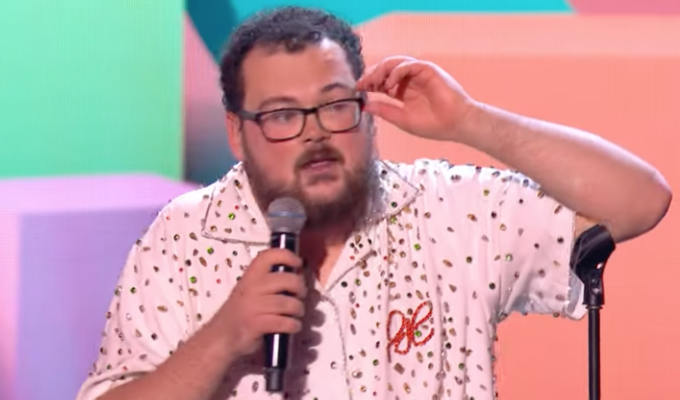
Alex Mitchell wows Britain’s Got Talent
Comedian Alex Mitchell wowed judges and the audience…
31/05/2024
We do not currently hold contact details for Alex Mitchell's agent. If you are a comic or agent wanting your details to appear here, for a one-off fee of £59, email steve@chortle.co.uk.
We see you are using AdBlocker software. Chortle relies on advertisers to fund this website so it’s free for you, so we would ask that you disable it for this site. Our ads are non-intrusive and relevant. Help keep Chortle viable.
